All comparisons
AI Sales Agents

Best AI Sales Agents in 2026

Compare the best AI sales agents for prospecting, outbound calling, lead qualification, follow-up, appointment setting, and sales workflow automation.

Overview
What is an AI sales agent?

What is an AI sales agent?

An AI sales agent is software designed to execute sales work rather than simply assist a salesperson with individual tasks.

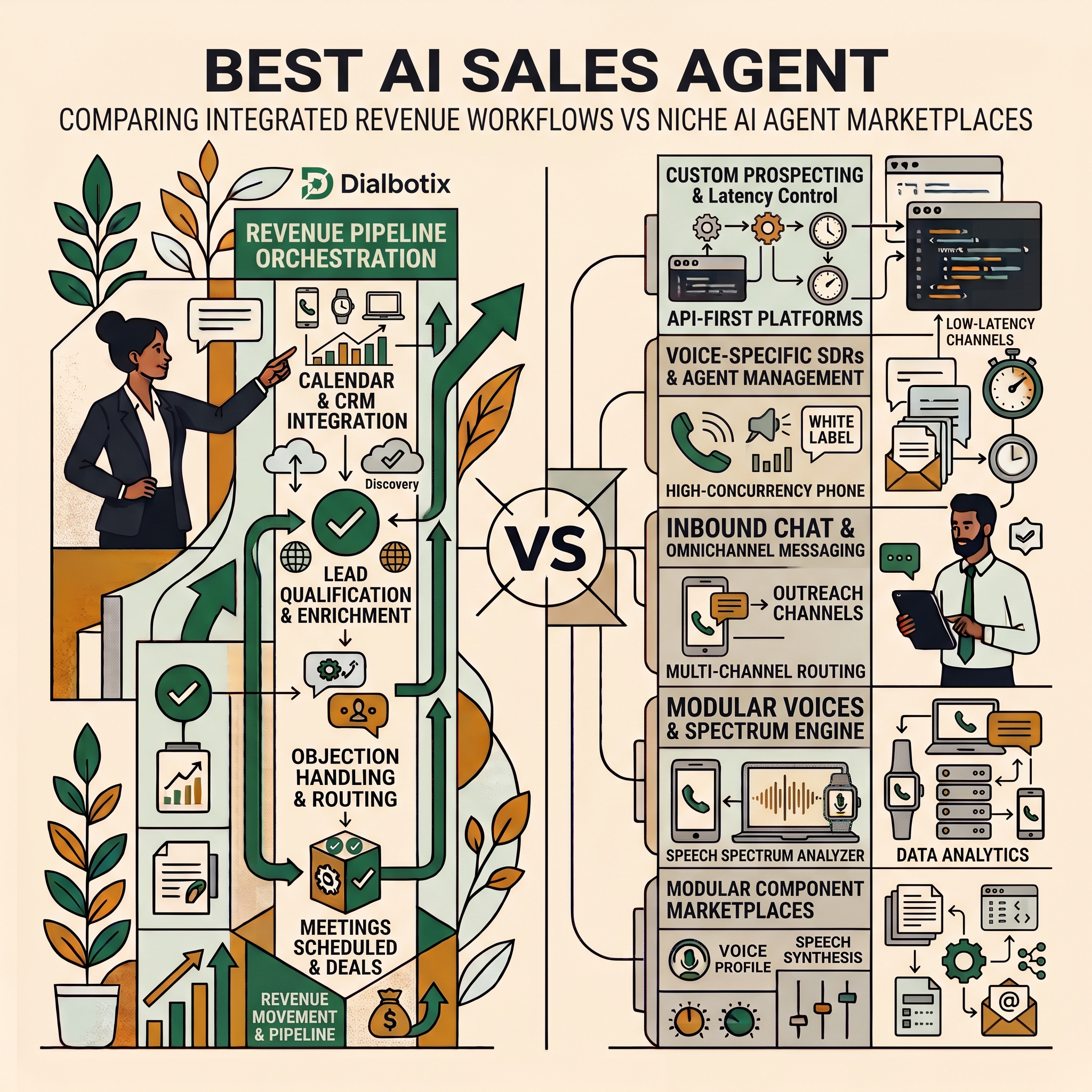
The term AI sales agent now covers several different categories of software. Some agents prospect and send outbound email, some make and receive phone calls, and others combine prospecting, engagement, qualification, and meeting booking into a broader autonomous sales workflow.

That distinction matters because a company looking for an AI phone agent has a very different requirement from a company looking for an autonomous email SDR. A platform can be excellent at one part of the sales process while being a poor fit for another.

The strongest AI sales agents can execute repetitive parts of the sales process with limited human intervention. Depending on the platform, this can include finding prospects, researching accounts, initiating conversations, handling replies, making calls, qualifying leads, following up, and booking meetings.

For buyers, the important question is not simply which platform has the most AI features. The better question is which platform can automate the specific part of your sales process that is currently consuming the most human time.

Who it's for

Who are AI sales agents best for?

AI sales agents are most valuable when sales teams have repetitive, high-volume workflows where success can be measured through qualified leads, meetings, and pipeline.

Lean sales teams

Small teams can automate repetitive prospecting and qualification work without immediately adding additional SDR capacity.

High-volume outbound teams

Teams with large lead lists can use AI agents to consistently contact prospects without requiring representatives to manually work every record.

Teams with qualification bottlenecks

AI agents can conduct initial qualification and identify prospects that meet predefined sales criteria.

Appointment-driven businesses

Businesses where the primary conversion is a qualified meeting can automate outreach, qualification, and scheduling.

Teams with follow-up gaps

AI agents can maintain consistent follow-up with prospects who showed interest but did not immediately convert.

Companies with large lead databases

Existing CRM databases can become actionable sales pipelines instead of remaining dormant because sales teams lack the capacity to contact every lead.

Methodology

How we evaluate AI sales agents

AI sales agents should be evaluated by the amount and quality of sales work they can actually execute, not by the number of AI features listed on a product page.

  1. 01

    Sales execution

    How much of the sales workflow can the platform execute without requiring a human at every step?

  2. 02

    Voice capability

    Can the agent conduct natural phone conversations, ask questions, handle objections, and determine intent?

  3. 03

    Lead qualification

    Can teams define qualification rules and reliably distinguish qualified prospects from low-intent leads?

  4. 04

    Appointment booking

    Can the agent convert qualified conversations into scheduled meetings?

  5. 05

    Outbound automation

    Can the platform initiate and manage meaningful outbound sales activity at scale?

  6. 06

    Multichannel support

    Does the platform support email, phone, LinkedIn, SMS, or other channels when the sales motion requires them?

  7. 07

    CRM integration

    Can sales activity, qualification data, outcomes, and conversations be synchronized with the CRM?

  8. 08

    Autonomy

    How much ongoing human supervision is required after the agent has been configured?

  9. 09

    Deployment speed

    How quickly can a sales team configure, test, and launch the agent?

  10. 10

    Customization

    Can the agent follow company-specific qualification criteria, prompts, workflows, and escalation rules?

At a glance

Best AI sales agents compared

The platforms below represent different approaches to AI sales automation, from voice-first agents to autonomous SDRs, sales intelligence platforms, and CRM-native AI agents.

DialbotixThis one

From $79/mo

Voice AI
Native
Lead Qualification
Advanced
Booking
Native
CRM
Outbound
Voice-first
11x

Sales-led

Voice AI
Lead Qualification
Advanced
Booking
CRM
Outbound
Multichannel
Artisan

Sales-led / usage-based

Voice AI
Limited
Lead Qualification
Booking
CRM
Outbound
Multichannel
AiSDR

Published / usage-based

Voice AI
Lead Qualification
Booking
CRM
Outbound
Multichannel
Regie.ai

Sales-led

Voice AI
Lead Qualification
Booking
CRM
Outbound
Multichannel
Apollo

Subscription

Voice AI
Limited
Lead Qualification
AI-assisted
Booking
CRM
Native
Outbound
Multichannel
Qualified

Sales-led

Voice AI
Lead Qualification
Inbound-focused
Booking
CRM
Outbound
Inbound-focused
Salesforce Agentforce

Usage-based

Voice AI
Via ecosystem
Lead Qualification
Booking
CRM
Native
Outbound
Workflow-based
IncludedNot available
Verdict

Our ranking of the best AI sales agents

This ranking emphasizes practical sales execution, qualification, conversation quality, booking, automation depth, deployment speed, and fit for real sales teams.

1

Dialbotix

Best AI Voice Sales Agent

Dialbotix is a no-code AI voice agent platform built specifically around outbound sales conversations. Users can set up an AI voice agent in about two minutes without writing code, connect leads, launch campaigns, qualify prospects through live conversations, and book meetings.

Why it ranks here — Dialbotix is the strongest fit when the central sales problem is actually talking to leads. Instead of treating voice as an optional feature inside a broader sales platform, it makes AI voice conversations, qualification, follow-up, and appointment booking the core workflow.

Strengths
  • No-code AI voice agent setup
  • Outbound calling
  • Real-time conversational qualification
  • Automatic meeting booking
  • Campaign management
  • CRM synchronization
  • Google Calendar integration
  • Call transcripts and recordings
  • Live call monitoring
  • Live transcripts
  • Call summaries and analytics
  • Webhooks and API
  • Multi-agent support
Trade-offs
  • More specialized around voice-led sales than broad email-first autonomous SDR platforms
  • Teams primarily focused on email and LinkedIn prospecting may prefer a multichannel-first platform
Pricing

Starter $79/month for 300 AI calling minutes, Growth $149/month for 800 minutes, Scale $299/month for 2,000 minutes, with pay-as-you-go calling also available.

Best for

Sales teams that already have leads and want an AI agent to call, qualify, follow up, and book meetings.

2

11x

Best for Autonomous Multichannel Sales

11x focuses on autonomous digital workers designed to execute sales development and broader go-to-market tasks across multiple channels.

Why it ranks here — 11x is one of the better-known options for companies seeking a broader autonomous sales worker rather than a specialized single-channel agent.

Strengths
  • Autonomous sales workflows
  • Multichannel outbound
  • AI digital workers
  • Prospecting
  • Research
  • Outbound engagement
  • Enterprise-oriented workflows
Trade-offs
  • Broader workflows can introduce more complexity
  • More enterprise-oriented than simple no-code voice products
  • Voice is only one part of its broader sales-agent strategy
Pricing

Primarily sales-led and positioned toward larger deployments.

Best for

Organizations looking for broader autonomous outbound and GTM execution.

3

Artisan

Best AI BDR

Artisan's AI BDR approach focuses on automating prospecting, research, personalization, outbound messaging, follow-up, and meeting generation.

Why it ranks here — Artisan is particularly strong for companies that want an AI sales development representative handling a broad outbound workflow rather than only making phone calls.

Strengths
  • AI BDR workflow
  • Prospect discovery
  • Research and enrichment
  • Personalized outbound
  • Automated follow-up
  • Meeting generation
  • Large prospect database
Trade-offs
  • More centered on digital outbound than voice
  • Not the ideal fit for a phone-first sales organization
  • Broader workflows can require more configuration
Pricing

Pricing varies by plan, volume, and deployment.

Best for

Lean teams seeking broad AI-powered outbound prospecting.

4

AiSDR

Best Accessible AI SDR

AiSDR automates sales development activities including prospect research, personalized outreach, follow-up, qualification, and meeting generation.

Why it ranks here — AiSDR is a practical option for smaller teams looking to automate a large portion of outbound sales development without building a custom system.

Strengths
  • Outbound prospecting
  • AI personalization
  • Lead research
  • Automated follow-up
  • Meeting booking
  • Multichannel capabilities
Trade-offs
  • Less specialized around voice than Dialbotix
  • Digital outbound remains a major part of the workflow
  • Performance depends on lead data and targeting quality
Pricing

Published and usage-based options vary by plan.

Best for

Small and growing teams wanting accessible AI SDR automation.

5

Regie.ai

Best Human-AI Sales Workflow

Regie.ai combines AI-powered prospecting and engagement with sales development workflows designed to support human revenue teams.

Why it ranks here — Regie is a strong fit when a company wants AI to execute and accelerate sales development while retaining humans in important parts of the workflow.

Strengths
  • AI prospecting
  • Sales engagement
  • AI-generated messaging
  • Multichannel workflows
  • Human-in-the-loop controls
  • Enterprise sales capabilities
Trade-offs
  • Not as specialized for autonomous voice calling
  • Can require more sales-process configuration
  • Better fit for established sales organizations
Pricing

Generally sales-led for larger deployments.

Best for

Sales organizations that want AI augmentation rather than fully autonomous sales execution.

6

Apollo

Best Sales Intelligence Platform

Apollo combines prospect data, sales intelligence, sequencing, engagement, and AI-assisted workflows in a broader sales platform.

Why it ranks here — Apollo is particularly useful when prospect data and outbound infrastructure are as important as AI automation.

Strengths
  • Large B2B prospect database
  • Sales intelligence
  • Email sequencing
  • Multichannel engagement
  • CRM integrations
  • AI-assisted sales workflows
Trade-offs
  • AI agents are not the sole focus
  • Voice automation is not its main differentiator
  • Teams seeking autonomous phone qualification may need a specialized platform
Pricing

Subscription-based pricing with different feature and usage levels.

Best for

Sales teams that need data, prospecting, engagement, and AI assistance together.

7

Qualified

Best for Inbound Sales

Qualified focuses on AI-powered inbound sales engagement, qualification, and meeting generation for companies using website traffic as an important source of pipeline.

Why it ranks here — Qualified is a strong choice when the sales problem begins with inbound website visitors rather than large cold outbound lead lists.

Strengths
  • Inbound lead qualification
  • Website engagement
  • AI sales conversations
  • Meeting booking
  • CRM integration
  • Enterprise revenue workflows
Trade-offs
  • More inbound-focused than outbound-first platforms
  • Less suitable for large cold-calling campaigns
  • Enterprise-oriented deployment can be more involved
Pricing

Sales-led pricing.

Best for

B2B companies with substantial inbound website traffic and high-value leads.

8

Salesforce Agentforce

Best CRM-Native AI

Salesforce Agentforce provides AI agents that operate within the Salesforce ecosystem and can use CRM context to execute and automate sales workflows.

Why it ranks here — For organizations already deeply invested in Salesforce, native CRM context and governance can outweigh the benefits of adopting a standalone sales-agent platform.

Strengths
  • Native Salesforce context
  • CRM data access
  • Enterprise governance
  • Workflow automation
  • Sales process integration
  • Broad enterprise ecosystem
Trade-offs
  • Best suited to Salesforce-centric organizations
  • Can be more complex than specialized AI sales platforms
  • Not primarily a voice-first outbound calling product
Pricing

Usage and deployment model varies by Salesforce configuration and Agentforce usage.

Best for

Enterprise teams already operating deeply inside Salesforce.

Deep dive

AI sales agents: detailed comparison

AI voice sales agents

Voice agents conduct live conversations with prospects. They are particularly useful when qualification requires asking questions, handling objections, and determining intent in real time.

AI SDR agents

AI SDRs typically focus on prospecting, research, personalized outreach, follow-up, and meeting generation across email and other digital channels.

Autonomous sales agents

Autonomous agents attempt to execute larger portions of the sales process with less human intervention, potentially spanning research, outreach, qualification, and scheduling.

Outbound calling

Outbound voice agents can work through large lead lists and conduct initial sales conversations without requiring a representative to manually dial every prospect.

Lead qualification

Qualification determines whether a prospect meets predefined requirements. Strong agents can ask dynamic questions rather than simply follow a static script.

Appointment booking

AI agents can connect qualification with calendar availability so qualified prospects can move directly from conversation to scheduled meeting.

Multichannel sales automation

Multichannel agents combine channels such as email, phone, LinkedIn, SMS, or other messaging systems. This can increase coverage but also increases workflow complexity.

CRM integration

CRM integration allows agents to update records, store qualification results, log activities, and provide human salespeople with conversation context.

No-code AI sales agents

No-code platforms allow sales teams to configure agents and launch workflows without engineering resources. This can significantly reduce deployment time.

AI sales agent customization

Customization includes prompts, qualification criteria, sales messaging, objection handling, escalation logic, booking rules, and other company-specific behavior.

AI sales analytics

Analytics should expose more than activity volume. Qualified conversations, booked meetings, conversion rates, objections, and pipeline outcomes are more meaningful measures.

Cost of AI sales agents

Pricing models range from subscriptions and per-user plans to usage-based calling and enterprise contracts. Cost should be evaluated against qualified outcomes rather than raw activity.

Decision guide

How to choose the right AI sales agent

Start with your sales bottleneck, then choose the type of agent that directly addresses it.

1

Define the sales bottleneck

Identify whether the biggest problem is prospecting, outreach, calling, qualification, follow-up, inbound response, or meeting booking.

2

Choose your primary channel

Determine whether your sales motion is primarily phone, email, LinkedIn, inbound, or genuinely multichannel.

3

Decide the required autonomy

Some teams want AI assistance while others want an agent that independently executes most of the workflow. Make this distinction before comparing products.

4

Test real conversations

If voice is important, test actual calls. Evaluate interruptions, objections, context retention, qualification accuracy, and how the agent handles unexpected responses.

5

Verify integrations

Check CRM, calendar, lead-source, webhook, and API requirements before committing to a platform.

6

Measure qualified outcomes

Compare cost per qualified lead, booked meeting, attended meeting, and pipeline opportunity instead of optimizing for call or message volume alone.

Use cases

AI sales agent use cases

The strongest AI sales-agent use cases are repetitive sales activities where speed, consistency, and volume matter.

Outbound lead qualification

Automatically contact leads, ask qualification questions, identify intent, and route qualified prospects to human sales representatives.

Appointment setting

Engage prospects, qualify them against predefined criteria, and schedule qualified meetings directly on the sales team's calendar.

Cold lead reactivation

Work through dormant CRM records and determine whether previously inactive prospects are now interested.

Speed-to-lead

Respond to new leads quickly and qualify them while intent is still high.

High-volume outbound campaigns

Run structured sales campaigns across large lead lists without requiring representatives to manually initiate every interaction.

Automated follow-up

Continue conversations with prospects who expressed interest but did not immediately schedule a meeting.

Event follow-up

Contact webinar, event, or conference leads and identify which prospects are ready for a sales conversation.

Lead routing

Use AI-collected information to determine which prospects should be passed to sales and which should continue through automated nurturing.

SDR augmentation

Allow AI to handle repetitive top-of-funnel activity while human representatives focus on discovery, negotiation, and closing.

Pricing

How much do AI sales agents cost?

There is no single pricing model for AI sales agents. Products range from low-cost sales assistants to usage-based voice agents and enterprise autonomous sales platforms.

Dialbotix pricing

Dialbotix offers straightforward pricing for its AI voice agent platform. Starter costs $79/month for 300 AI calling minutes, Growth costs $149/month for 800 minutes, and Scale costs $299/month for 2,000 minutes. Pay-as-you-go calling is available at $0.25 per call minute, with a 14-day free trial.

See full pricing
What affects total cost
AI calling minutesNumber of leads processedOutbound campaign volumeNumber of AI agentsProspecting and enrichment usageEmail and social outreach volumeCRM integrationsAPI and automation usageEnterprise supportCustom implementation

The cheapest AI sales agent is not necessarily the lowest-cost sales solution. Compare qualified conversations, booked meetings, attended meetings, and pipeline generated against total platform and usage costs.

FAQ

Frequently asked questions about AI sales agents

What is an AI sales agent?

An AI sales agent is software that can autonomously execute parts of a sales workflow such as prospecting, outreach, qualification, calling, follow-up, or appointment booking.

What is the best AI sales agent in 2026?

There is no universal winner because the category includes voice agents, AI SDRs, and broader GTM agents. Dialbotix is a strong choice for teams that specifically need AI-powered outbound calling, qualification, follow-up, and appointment booking.

Can AI sales agents make phone calls?

Yes. Some AI sales agents can initiate and conduct real-time phone conversations. Voice capability varies substantially, so buyers should evaluate the actual conversation experience rather than simply whether a product has a dialer.

Can AI sales agents qualify leads?

Yes. AI sales agents can use predefined qualification criteria and conversational questions to determine whether prospects meet a company's requirements.

Can AI sales agents book meetings?

Yes. Many AI sales agents can connect to calendars and schedule qualified prospects automatically.

Can AI sales agents replace SDRs?

They can automate substantial portions of SDR work, particularly repetitive prospecting, qualification, outreach, and follow-up. They should not automatically be treated as complete replacements for human salespeople in complex sales.

What is the difference between an AI SDR and an AI sales agent?

AI SDR generally refers to automation focused on sales development and top-of-funnel activities. AI sales agent is a broader term that can include prospecting, phone conversations, qualification, follow-up, inbound engagement, and appointment booking.

What is the best AI sales agent for outbound calling?

For a voice-first outbound sales workflow, Dialbotix is designed specifically around calling leads, conducting qualification conversations, following up, and booking meetings.

Do AI sales agents work with CRMs?

Many do. CRM depth varies by platform, so buyers should verify whether the agent can create and update the specific records, fields, activities, and outcomes their sales process requires.

Do I need coding skills to use an AI sales agent?

Not always. No-code AI sales platforms are designed for sales teams to configure agents without engineering. Dialbotix, for example, is designed to let users create an AI voice agent without writing code.

How long does it take to deploy an AI sales agent?

Deployment time varies from minutes for focused no-code products to significantly longer implementations for enterprise or highly customized systems.

How much does an AI sales agent cost?

Pricing ranges from relatively low monthly subscriptions to usage-based and enterprise sales-led contracts. Dialbotix starts at $79/month for its AI voice agent plans.

Are AI sales agents useful for small businesses?

Yes. They can be especially useful when a small team has more leads than it can manually contact or follow up with.

What should I measure when evaluating an AI sales agent?

Measure qualified conversations, qualified leads, booked meetings, attended meetings, pipeline contribution, conversion rates, and cost per qualified outcome. Activity volume alone is a weak metric.

Are AI sales agents only for outbound sales?

No. AI agents can also handle inbound qualification, website conversations, lead routing, customer follow-up, and other revenue workflows depending on the platform.

Build your AI sales agent in minutes

Set up a no-code AI voice agent, connect your leads, launch outbound campaigns, qualify prospects through real conversations, and book meetings automatically.