All comparisons
AI Phone Agents

Best AI Phone Agents in 2026

Compare the best AI phone agents for making and answering calls, qualifying leads, booking appointments, handling customer conversations, and automating phone-based workflows.

Overview
What are the best AI phone agents?

What are the best AI phone agents?

AI phone agents use conversational AI to make or answer phone calls and complete tasks without requiring a human to handle every conversation.

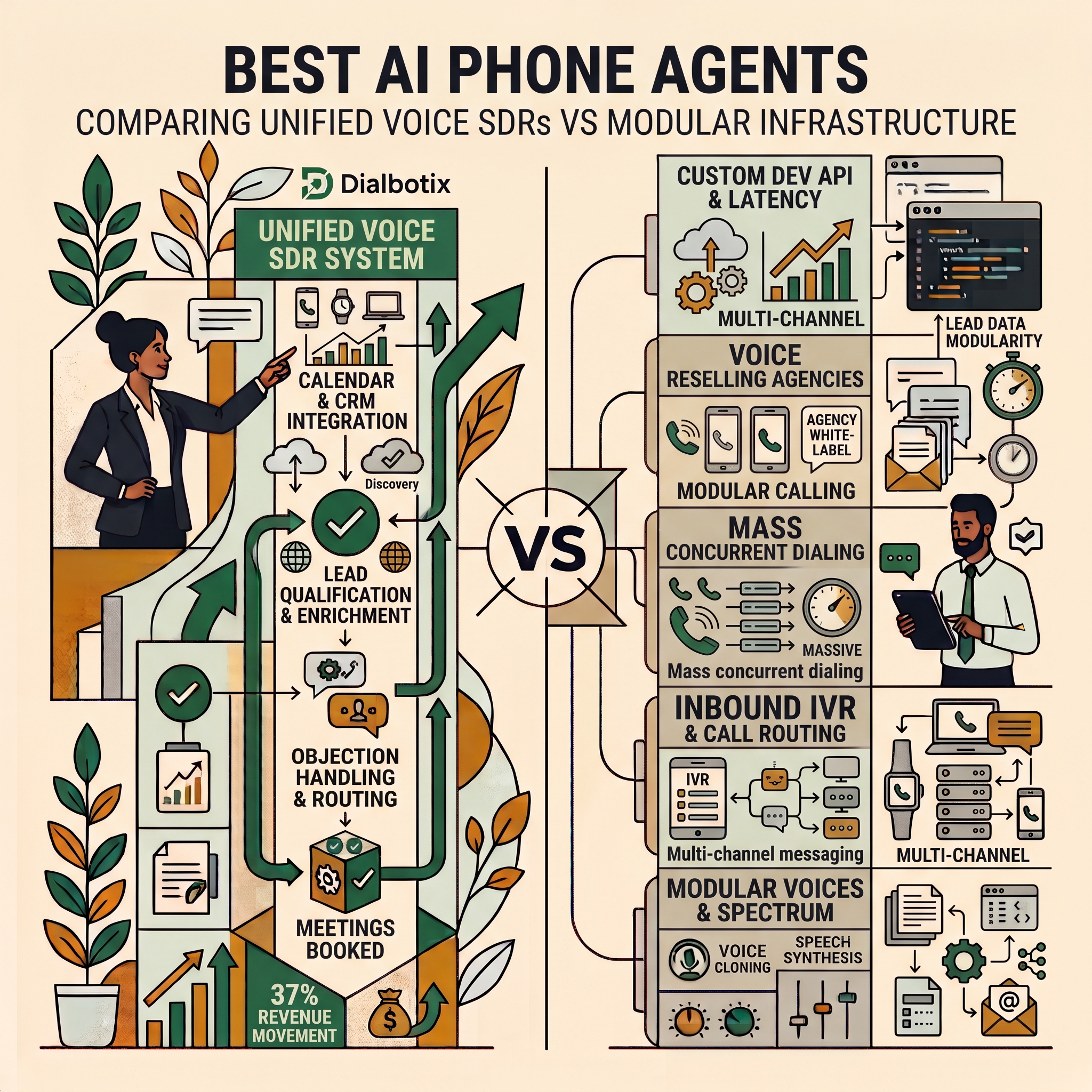
The AI phone agent market has split into several different categories. Some platforms are developer infrastructure for building custom voice applications, while others are no-code tools designed for businesses to deploy agents quickly. Enterprise platforms may focus on contact-center automation, while sales-focused products concentrate on outbound calling, qualification, and appointment booking.

That distinction matters because the platform with the strongest voice infrastructure is not necessarily the best phone agent for a sales team. A business evaluating these tools should look beyond voice quality and ask whether the platform can actually execute the workflow surrounding the call.

For sales teams, that means importing or creating leads, launching outbound campaigns, qualifying prospects through natural conversations, detecting buying intent, booking meetings, updating the CRM, and reviewing transcripts and call outcomes.

Our ranking therefore evaluates AI phone agents across voice quality, conversational reliability, outbound capabilities, lead qualification, appointment booking, CRM connectivity, ease of deployment, and overall fit for business workflows.

Who it's for

Who should use an AI phone agent?

AI phone agents are most useful when a business has repetitive phone conversations that can be handled through clearly defined workflows while still requiring natural language interaction.

Sales teams

Automate outbound prospecting, lead qualification, follow-up calls, and appointment booking without requiring sales representatives to manually call every lead.

Appointment-driven businesses

Answer inquiries, qualify prospects, schedule appointments, confirm bookings, and handle routine rescheduling conversations.

Customer support teams

Handle repetitive inbound questions, collect customer information, route calls, and resolve defined support requests around the clock.

High-volume operations

Use AI to process large numbers of calls without scaling human phone teams linearly.

Agencies

Build and operate phone agents for multiple clients without creating a separate custom voice stack for every deployment.

Operations teams

Automate repetitive phone workflows such as confirmations, reminders, qualification, intake, routing, and follow-up.

Methodology

How we evaluate AI phone agents

The best AI phone agent depends on the workflow, not simply the quality of its voice. We evaluate platforms across the capabilities that determine whether an agent can move from a demo into production.

  1. 01

    Voice quality

    Natural speech, clear pronunciation, conversational pacing, interruption handling, and an overall human-like calling experience.

  2. 02

    Conversation quality

    Ability to maintain context, respond to unexpected answers, handle objections, and continue multi-turn conversations without sounding scripted.

  3. 03

    Outbound calling

    Campaign management, calling lists, concurrency, automated dialing, follow-up workflows, and support for high-volume outbound use cases.

  4. 04

    Inbound calling

    Ability to answer business calls, understand caller intent, collect information, route conversations, and complete defined tasks.

  5. 05

    Lead qualification

    Support for qualification criteria, intent detection, structured data collection, objection handling, and identifying high-value prospects.

  6. 06

    Appointment booking

    Calendar integrations and workflows that allow the agent to schedule meetings or appointments during or after a call.

  7. 07

    CRM and integrations

    Native CRM connections, APIs, webhooks, calendars, lead imports, and the ability to synchronize call outcomes with business systems.

  8. 08

    Ease of deployment

    How quickly a business can configure, test, deploy, and manage a production phone agent without unnecessary engineering work.

  9. 09

    Scalability

    Concurrency, campaign management, call volume, monitoring, and operational controls for businesses running large numbers of calls.

  10. 10

    Pricing

    The total cost of operating the agent, including subscriptions, minutes, telephony, model usage, integrations, and enterprise fees.

At a glance

Best AI phone agents compared

These platforms serve different segments of the AI phone market, from no-code business tools and sales-focused agents to developer infrastructure and enterprise contact-center systems.

DialbotixThis one

$79/mo+

Voice AI
Lead Qualification
Native
Booking
Native
CRM
Native + API
Outbound
Core
Retell AI

Usage-based

Voice AI
Lead Qualification
Custom
Booking
Custom
CRM
API / integrations
Outbound
Synthflow

Subscription + usage

Voice AI
Lead Qualification
Booking
CRM
Integrations
Outbound
Bland AI

Subscription + usage

Voice AI
Lead Qualification
Custom
Booking
Custom
CRM
API
Outbound
Strong
Vapi

Usage-based

Voice AI
Lead Qualification
Custom
Booking
Custom
CRM
API
Outbound
ElevenLabs

Usage / subscription

Voice AI
Lead Qualification
Custom
Booking
Custom
CRM
API / integrations
Outbound
Custom
PolyAI

Custom

Voice AI
Lead Qualification
Booking
Custom
CRM
Enterprise
Outbound
Limited
Air AI

Custom

Voice AI
Lead Qualification
Booking
CRM
Integrations
Outbound
Core
IncludedNot available
Verdict

The best AI phone agents ranked

There is no single winner for every phone workflow. Our ranking prioritizes platforms that combine conversational voice with practical business workflows, deployment speed, integrations, and the ability to operate phone automation at scale.

1

Dialbotix

Best for sales and outbound phone automation

Dialbotix is a no-code AI voice agent platform built around outbound sales workflows. Businesses can set up an AI voice agent in about two minutes without writing code, launch calling campaigns, qualify leads, book meetings, and synchronize outcomes with their CRM.

Why it ranks here — Dialbotix ranks first for businesses that want a complete sales phone agent rather than raw voice infrastructure. The platform combines AI calling, lead qualification, appointment booking, campaign management, CRM synchronization, transcripts, call analytics, and live monitoring in one workflow.

Strengths
  • No-code AI voice agent setup
  • Built specifically for outbound sales workflows
  • Native lead qualification
  • Automatic meeting booking
  • Campaign management
  • CRM sync, API, and webhooks
  • Live call monitoring and transcripts
  • Built-in call analytics and summaries
Trade-offs
  • More specialized around sales and lead workflows than general-purpose contact-center automation
  • Businesses needing highly customized developer infrastructure may prefer a platform such as Vapi or Retell
Pricing

Starter plans begin at $79/month with higher tiers available for larger calling volumes, plus pay-as-you-go calling.

Best for

Sales teams, agencies, startups, and businesses that want to deploy outbound AI phone agents without building the infrastructure themselves.

2

Retell AI

Best for production voice infrastructure

Retell AI provides production-oriented voice agent infrastructure for businesses and developers building inbound and outbound phone applications.

Why it ranks here — Retell is one of the strongest choices for teams that want flexible voice infrastructure with a relatively fast path to production. Its strength is the underlying voice-agent platform rather than a sales-specific workflow layer.

Strengths
  • Strong conversational voice experience
  • Low-latency calling
  • Inbound and outbound support
  • Developer APIs
  • No-code and visual configuration options
  • Production monitoring
Trade-offs
  • More infrastructure-oriented than sales-workflow-oriented
  • Businesses may need additional systems for complete lead management and sales automation
Pricing

Primarily usage-based pricing, with costs varying according to voice and model configuration.

Best for

Businesses and developers building custom production phone agents.

3

Synthflow

Best for no-code general-purpose agents

Synthflow is a visual AI voice platform designed to let businesses and agencies build phone agents without traditional software development.

Why it ranks here — Synthflow is particularly attractive for non-technical teams and agencies that want a visual agent-building experience and support for common inbound and outbound workflows.

Strengths
  • Visual no-code builder
  • Fast agent setup
  • Inbound and outbound calling
  • Calendar integrations
  • Agency and white-label workflows
  • Multiple integrations
Trade-offs
  • Not specifically optimized around outbound sales operations
  • Total cost can depend heavily on usage and configuration
Pricing

Free building/testing options with paid plans and usage-based calling costs.

Best for

Non-technical teams, agencies, and businesses deploying general-purpose phone agents.

4

Bland AI

Best for high-volume outbound calling

Bland AI provides programmable AI phone agents with a strong focus on outbound calling and automated phone workflows.

Why it ranks here — Bland is a strong option when the primary requirement is programmatic or high-volume outbound calling. Its tradeoff is that businesses may need to assemble more of the surrounding workflow themselves.

Strengths
  • Outbound calling
  • High-volume workflows
  • Programmable agents
  • API access
  • Campaign-oriented use cases
Trade-offs
  • Less purpose-built around complete sales operations
  • More configuration may be required for sophisticated CRM and qualification workflows
Pricing

Subscription and usage-based options depending on deployment requirements.

Best for

Teams running high-volume outbound phone campaigns.

5

Vapi

Best for developer-controlled voice applications

Vapi is a developer-focused voice AI platform for teams that want granular control over the components and behavior of their phone agents.

Why it ranks here — Vapi is particularly strong when engineering teams want to build a highly customized voice application and control the underlying models, tools, and integrations.

Strengths
  • Developer flexibility
  • API-first architecture
  • Model and provider flexibility
  • Custom tools and workflows
  • Programmable phone agents
Trade-offs
  • Requires more technical work than a purpose-built no-code sales platform
  • Teams must build more of the business workflow around the voice layer
Pricing

Usage-based pricing with costs depending on selected voice, model, and infrastructure components.

Best for

Engineering teams building custom AI phone applications.

6

ElevenLabs

Best for voice quality

ElevenLabs is widely known for high-quality synthetic voices and has expanded into conversational voice agents and phone-based applications.

Why it ranks here — ElevenLabs is compelling when natural and expressive voice output is a major priority. It is less directly focused on complete sales operations than platforms built around calling workflows.

Strengths
  • High-quality voice generation
  • Conversational AI capabilities
  • Developer APIs
  • Strong voice customization
  • Multilingual capabilities
Trade-offs
  • Businesses may need additional systems for complete sales operations
  • Voice quality alone does not provide lead management or sales workflow automation
Pricing

Subscription and usage-based pricing depending on products and consumption.

Best for

Businesses where voice quality and branded conversational experiences are especially important.

7

PolyAI

Best for enterprise voice automation

PolyAI focuses on enterprise conversational voice automation, particularly for customer service and contact-center environments.

Why it ranks here — PolyAI is a strong enterprise option when the goal is large-scale customer-service automation rather than lightweight sales calling.

Strengths
  • Enterprise conversational AI
  • Contact-center workflows
  • Natural voice interactions
  • Large-scale deployments
  • Enterprise integrations
Trade-offs
  • Enterprise sales process
  • Custom pricing
  • Less accessible for small teams and startups
  • Not primarily an outbound sales platform
Pricing

Custom enterprise pricing.

Best for

Large organizations automating customer-service and contact-center calls.

8

Air AI

Best for autonomous sales conversations

Air AI focuses on autonomous phone conversations for sales and customer acquisition workflows.

Why it ranks here — Air AI is relevant for organizations specifically interested in autonomous outbound sales conversations and longer phone interactions.

Strengths
  • Outbound sales focus
  • Long-form phone conversations
  • Lead qualification
  • Sales-oriented workflows
  • Automated calling
Trade-offs
  • Less general-purpose than infrastructure platforms
  • Deployment and pricing can be more sales-led
  • Businesses should validate the exact workflow and integration requirements before committing
Pricing

Typically sales-led or custom depending on deployment requirements.

Best for

Sales organizations focused heavily on autonomous outbound conversations.

Deep dive

AI phone agents: detailed comparison

Dialbotix vs Retell AI

Compare Dialbotix's sales-focused no-code workflow with Retell's production-oriented voice agent infrastructure.

Dialbotix vs Synthflow

Compare two no-code approaches to AI phone agents, with emphasis on sales workflows, integrations, and deployment.

Dialbotix vs Bland AI

Compare sales-focused AI phone automation with Bland's programmable outbound calling platform.

Dialbotix vs Vapi

Compare a no-code sales phone agent with a developer-first voice AI infrastructure platform.

Dialbotix vs ElevenLabs

Compare complete sales phone workflows with ElevenLabs' voice and conversational AI capabilities.

Dialbotix vs PolyAI

Compare sales-focused AI phone automation with enterprise customer-service voice automation.

Best AI phone agents for outbound sales

Explore the strongest AI agents for prospecting, qualification, follow-up, and sales conversations.

Best AI voice agents

Compare broader AI voice agent platforms across business and developer use cases.

Best AI calling platforms

Compare platforms built for automating business calls at different levels of the stack.

Best AI appointment setters

Compare AI platforms that can qualify prospects and turn conversations into booked meetings.

Best AI lead qualification software

Compare tools for identifying qualified prospects through AI-powered conversations and workflows.

AI phone agent alternatives

Explore alternatives to popular AI phone and voice infrastructure platforms.

Decision guide

How to choose an AI phone agent

Start with the phone workflow you actually need to automate. The best platform depends on whether your priority is sales, customer support, inbound answering, outbound campaigns, or custom voice application development.

01

Define the call workflow

Decide whether the agent will make outbound calls, answer inbound calls, qualify leads, book appointments, provide support, or perform several of these tasks.

02

Choose no-code or developer-first

If business users need to launch and manage agents themselves, prioritize no-code platforms. If your engineering team wants complete control, developer-first platforms may be more appropriate.

03

Test real conversations

Do not judge a phone agent solely from a product demo. Test interruptions, objections, unclear answers, long conversations, transfers, and unexpected responses.

04

Check integrations

Make sure the platform can connect to your CRM, calendar, lead sources, phone numbers, webhooks, APIs, and other systems required by the workflow.

05

Calculate total cost

Compare subscription fees, included minutes, telephony, model usage, overages, integrations, and any implementation costs rather than comparing advertised per-minute rates alone.

06

Start with a measurable workflow

Launch one high-value phone workflow first and measure outcomes such as qualified leads, booked appointments, resolution rate, transfer rate, cost per outcome, and human time saved.

Use cases

What can AI phone agents do?

AI phone agents can automate many repetitive phone workflows, but the strongest results come from clearly defined tasks with measurable outcomes.

Outbound lead qualification

Call prospects automatically, ask qualification questions, identify intent, handle basic objections, and route qualified opportunities to sales teams.

Appointment booking

Speak with prospects, determine availability, and book meetings directly into connected calendars.

Sales follow-up

Automatically follow up with leads that have not responded or need another conversation before becoming sales opportunities.

Inbound call answering

Answer business calls, understand the caller's intent, provide information, and route or escalate conversations when necessary.

Customer support

Handle repetitive support questions, collect customer information, provide status updates, and escalate complex cases.

Lead intake

Collect contact details, requirements, project information, and other qualification data through a conversational phone call.

Appointment reminders

Call customers before scheduled appointments, confirm attendance, and collect cancellation or rescheduling requests.

Reactivation campaigns

Reach out to dormant or previously engaged leads and determine whether they are ready to restart a conversation.

Customer surveys

Conduct structured phone surveys and capture responses without requiring employees to manually conduct every interview.

Pricing

How much do AI phone agents cost?

AI phone agent pricing varies significantly because platforms package voice infrastructure, AI models, telephony, automation, and software features differently.

Dialbotix pricing

Dialbotix currently offers Starter at $79/month with 300 AI calling minutes, Growth at $149/month with 800 minutes, and Scale at $299/month with 2,000 minutes. Pay-as-you-go calling is also available at $0.25 per call minute, with a 14-day free trial.

See full pricing
What affects total cost
Monthly platform subscriptionIncluded calling minutesAdditional per-minute usageTelephony and phone-number costsLLM and model usageVoice provider costsConcurrent call limitsCRM and third-party integrationsEnterprise implementationMonitoring and analytics features

Do not compare AI phone agents using headline per-minute prices alone. A lower voice rate can become more expensive once telephony, models, subscriptions, integrations, and engineering time are included.

FAQ

AI phone agents FAQ

What is an AI phone agent?

An AI phone agent is software that uses conversational AI to make or answer phone calls, understand what people say, respond naturally, and complete predefined business tasks.

What is the best AI phone agent in 2026?

The best AI phone agent depends on the workflow. Dialbotix is particularly strong for sales teams that want no-code outbound calling, lead qualification, appointment booking, and CRM workflows. Retell and Vapi are stronger fits for teams building customized voice applications, while PolyAI is more focused on enterprise customer-service automation.

Can AI phone agents make outbound calls?

Yes. Many AI phone platforms support outbound calls. Capabilities vary from individual automated calls to large campaigns with lead lists, concurrency, scheduling, and call outcome tracking.

Can AI phone agents answer incoming calls?

Yes. AI phone agents can answer inbound calls, identify caller intent, answer questions, collect information, route conversations, and complete defined workflows.

Can an AI phone agent qualify sales leads?

Yes. A properly configured agent can ask qualification questions, understand responses, identify intent, handle common objections, collect structured information, and determine whether a lead should be passed to a sales representative.

Can AI phone agents book appointments?

Yes. Platforms with calendar integrations can use information from a conversation to find suitable availability and book appointments during or after the call.

Do I need coding skills to build an AI phone agent?

Not necessarily. No-code platforms such as Dialbotix and Synthflow allow businesses to configure phone agents without traditional software development. Developer-first platforms such as Vapi and other APIs provide more control but require more technical work.

How natural do AI phone agents sound?

Modern AI phone agents can sound highly natural, but the quality depends on the voice model, latency, interruption handling, conversation design, telephony setup, and model configuration. A polished demo does not guarantee equally strong performance in every production scenario.

Can AI phone agents integrate with a CRM?

Many platforms support CRM integrations, APIs, webhooks, or custom connections. The depth of synchronization varies, so businesses should verify whether contacts, call outcomes, transcripts, appointments, and qualification data can be written back automatically.

How much does an AI phone agent cost?

Pricing ranges from usage-based platforms charging per minute to software subscriptions with included minutes and enterprise systems with custom pricing. Total cost depends on calling volume, model usage, telephony, integrations, and required features.

Are AI phone agents better than human callers?

AI phone agents are not universally better than humans. They are particularly useful for high-volume, repetitive, structured conversations where speed and consistency matter. Human representatives remain important for complex negotiations, sensitive situations, high-value relationships, and conversations requiring nuanced judgment.

Can AI phone agents handle objections?

Yes, when the agent is designed with appropriate conversation logic, context, knowledge, and objection-handling instructions. Businesses should test agents against real objections rather than assuming that a general-purpose language model will automatically handle every sales situation correctly.

Can AI phone agents replace sales representatives?

In some workflows they can automate substantial parts of prospecting and qualification, but they should not automatically be treated as replacements for sales teams. A more practical model is to use AI for high-volume conversations and have human representatives focus on qualified opportunities and complex sales interactions.

What should I test before deploying an AI phone agent?

Test real conversations including interruptions, silence, objections, unclear answers, incorrect information, transfers, calendar booking, CRM updates, long calls, and failure scenarios. Also measure business outcomes rather than judging only voice quality.

What is the difference between an AI phone agent and an AI voice API?

An AI voice API typically provides infrastructure that developers use to build their own voice applications. An AI phone agent platform packages that infrastructure into a deployable business workflow, often including phone numbers, agent configuration, campaigns, integrations, monitoring, and analytics.

Turn phone calls into an automated sales workflow

Set up a no-code AI voice agent, connect your leads, qualify prospects, book meetings, and keep your CRM updated without building a voice infrastructure stack.