All comparisons
Best AI Calling Platforms

The Best AI Calling Platforms in 2026

Compare the leading AI calling platforms for outbound sales, lead qualification, appointment setting, customer service, and automated phone conversations. Find the right platform for your team, workflow, and scale.

Overview
What are the best AI calling platforms?

What are the best AI calling platforms?

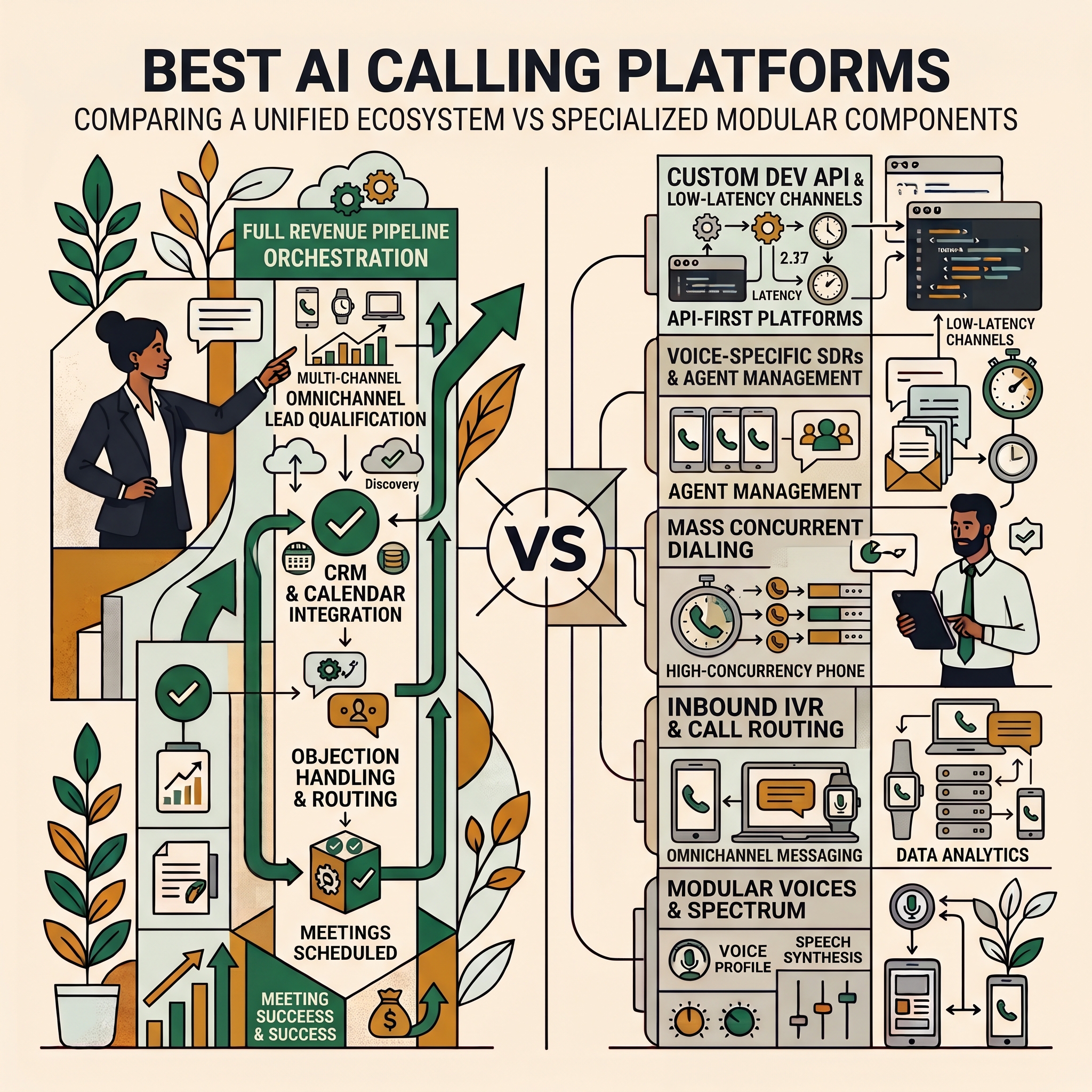
AI calling platforms allow businesses to automate phone conversations using conversational AI. The category now includes purpose-built sales products, no-code voice builders, developer infrastructure, and enterprise conversational platforms.

The important distinction is that an AI calling platform is more than a voice model. A production calling system needs telephony, real-time speech processing, conversation logic, campaign management, analytics, integrations, and reliable handling of real-world phone conversations.

For outbound sales, the platform also needs to turn calls into business outcomes. That means identifying interested prospects, qualifying leads, booking meetings, and synchronizing the results with the CRM.

Dialbotix is built specifically around that workflow. It provides AI voice calling, lead qualification, appointment booking, campaign management, CRM synchronization, transcripts, summaries, monitoring, and analytics without requiring a team to build the underlying voice stack.

Other platforms solve different parts of the problem. Retell provides production voice infrastructure, Vapi is highly developer-oriented, Synthflow emphasizes no-code voice automation, Bland AI focuses strongly on programmable and high-volume calling, and ElevenLabs is particularly strong in voice technology.

Who it's for

Who should use an AI calling platform?

AI calling can support several business workflows. The best platform depends on what you want the calls to accomplish.

Outbound sales teams

Automate repetitive prospecting, qualification, follow-up, and appointment-setting calls.

Lead generation teams

Call large lead lists and identify which prospects are genuinely interested before involving human sales representatives.

Appointment-driven businesses

Use AI conversations to qualify prospects and schedule appointments directly into connected calendars.

Customer service teams

Automate repetitive inbound calls, answer common questions, collect information, and route complex issues.

Customer reactivation teams

Reconnect with inactive customers, previous opportunities, and old CRM leads through automated calls.

Developers

Build custom phone applications when APIs, custom orchestration, and application-level control are more important than a packaged workflow.

Methodology

How we evaluate AI calling platforms

The best AI calling platform should be evaluated on the complete calling workflow rather than voice quality or a headline per-minute price alone.

  1. 01

    Outbound calling

    Evaluate campaign management, call initiation, lead-list handling, concurrency, and outbound workflow support.

  2. 02

    Voice quality

    The agent should sound natural, respond appropriately, and maintain a convincing conversation under real phone conditions.

  3. 03

    Latency

    Fast responses are important because long pauses make automated conversations feel unnatural.

  4. 04

    Conversation handling

    The system should handle interruptions, silence, objections, unexpected responses, and changes in conversation direction.

  5. 05

    Lead qualification

    Sales platforms should support structured qualification and capture useful outcomes from conversations.

  6. 06

    Appointment booking

    The platform should be able to connect qualified conversations to calendars and create meetings.

  7. 07

    CRM integration

    Call outcomes, transcripts, summaries, and qualification data should flow into the systems sales teams already use.

  8. 08

    Campaign management

    Evaluate whether teams can import leads, create campaigns, monitor progress, and manage calling workflows efficiently.

  9. 09

    Analytics

    Look for call outcomes, transcripts, summaries, qualification rates, campaign performance, and conversion metrics.

  10. 10

    Ease of deployment

    A platform that takes weeks of engineering to launch may not be appropriate when the business needs to start testing quickly.

At a glance

Best AI calling platforms compared

The leading platforms have different strengths. Dialbotix focuses on the complete outbound sales workflow, while other platforms emphasize voice infrastructure, no-code automation, high-volume calling, or enterprise conversational AI.

DialbotixThis one

$79/mo+

Voice AI
Lead Qualification
Built for sales
Booking
Built-in
CRM
Outbound
Core use case
Retell

Usage-based

Voice AI
Lead Qualification
Custom
Booking
Custom
CRM
Integrations
Outbound
Strong
Synthflow

Subscription/usage

Voice AI
Lead Qualification
Booking
CRM
Integrations
Outbound
Bland AI

Usage + plans

Voice AI
Lead Qualification
Booking
CRM
Integrations/webhooks
Outbound
Strong
Vapi

Usage-based

Voice AI
Lead Qualification
Custom
Booking
Custom
CRM
API/integrations
Outbound
ElevenLabs

Plan/usage

Voice AI
Lead Qualification
Custom
Booking
Custom
CRM
Custom
Outbound
Possible
PolyAI

Custom

Voice AI
Lead Qualification
Enterprise
Booking
Custom
CRM
Enterprise
Outbound
Not primary
IncludedNot available
Verdict

The best AI calling platforms in 2026

The ranking prioritizes business usefulness, especially for teams evaluating automated outbound calling. A different platform may be better if your priority is developer control, customer service, or large-scale infrastructure.

1

Dialbotix

Best for outbound sales

Dialbotix is a purpose-built AI voice agent platform for outbound sales. It combines AI calling, lead qualification, appointment booking, campaign management, CRM synchronization, transcripts, summaries, monitoring, and analytics.

Why it ranks here — Dialbotix ranks first for sales-focused AI calling because it treats calling as part of a complete sales workflow rather than as standalone telephony infrastructure. Teams can configure an AI voice agent without writing code and use it to call, qualify, and book meetings from lead lists.

Strengths
  • Purpose-built outbound sales workflow
  • No-code AI voice agent setup
  • AI lead qualification
  • Automatic meeting booking
  • Campaign management
  • CRM synchronization
  • Google Calendar integration
  • Live call monitoring
  • Live transcripts
  • AI call summaries
  • Call analytics
  • API and webhooks
Trade-offs
  • More specialized than general-purpose voice infrastructure
  • Primarily optimized for sales and outbound workflows
Pricing

Starter $79/month for 300 AI calling minutes; Growth $149/month for 800 minutes; Scale $299/month for 2,000 minutes; pay-as-you-go at $0.25 per call minute.

Best for

Sales teams that want an AI calling platform focused on qualification, appointment setting, and outbound revenue generation.

2

Retell

Best all-around voice infrastructure

Retell provides production-focused voice-agent infrastructure for businesses and developers building inbound and outbound phone agents.

Why it ranks here — Retell is a strong general-purpose choice for teams that need production voice infrastructure, fast deployment, telephony support, and developer flexibility.

Strengths
  • Production voice infrastructure
  • Low-latency conversations
  • Outbound calling
  • Batch calling
  • Developer APIs
  • Telephony integrations
  • Custom workflows
Trade-offs
  • Sales workflows may require additional configuration
  • More infrastructure-oriented than a dedicated sales application
  • Total cost depends on the complete voice stack
Pricing

Usage-based pricing, with the total cost depending on voice, model, and telephony configuration.

Best for

Businesses that want a strong general-purpose AI calling infrastructure layer.

3

Synthflow

Best no-code calling platform

Synthflow is a no-code voice AI platform designed for businesses that want to build and deploy phone agents without traditional software development.

Why it ranks here — Its visual builder lowers the barrier to launching AI calling workflows, making it especially useful for non-technical teams and agencies.

Strengths
  • No-code visual builder
  • Fast deployment
  • Voice automation
  • Appointment workflows
  • Business integrations
  • Inbound and outbound use cases
Trade-offs
  • Less specialized around outbound sales than Dialbotix
  • Complex custom workflows can require significant configuration
  • Pricing scales with usage and feature requirements
Pricing

Subscription and usage-based pricing depending on plan and configuration.

Best for

Non-technical teams that want to build AI calling workflows quickly.

4

Bland AI

Best for high-volume outbound

Bland AI provides programmable AI phone agents with a strong focus on outbound calling and large-scale phone workflows.

Why it ranks here — Bland is particularly relevant when the primary requirement is calling large volumes of contacts through programmable phone infrastructure.

Strengths
  • Outbound-first positioning
  • High-volume calling
  • Programmable phone agents
  • CRM and webhook workflows
  • Appointment scheduling
  • Enterprise capabilities
Trade-offs
  • More infrastructure-oriented than a complete sales application
  • Custom workflows can require additional implementation
  • Pricing varies by plan and usage
Pricing

Usage-based calling with different plan levels and enterprise options.

Best for

Growth teams running large outbound calling campaigns.

5

Vapi

Best for developers

Vapi is a developer-first voice AI platform for building custom phone agents using APIs, SDKs, and configurable voice components.

Why it ranks here — Vapi is highly flexible for engineering teams that want to own the application architecture and choose their voice, model, and telephony components.

Strengths
  • Developer-first architecture
  • API and SDK flexibility
  • Custom LLM options
  • Voice provider flexibility
  • Custom workflows
  • Application-level control
Trade-offs
  • Requires engineering resources
  • Sales workflows need to be assembled
  • Total cost depends on external model and telephony components
Pricing

Usage-based platform pricing with additional provider and telephony costs depending on configuration.

Best for

Developers building custom AI calling products.

6

ElevenLabs

Best for voice technology

ElevenLabs provides advanced voice and speech technology and has expanded into conversational AI and voice agents.

Why it ranks here — It is particularly strong when natural and expressive voice output is the highest priority, although complete sales workflows may require additional systems.

Strengths
  • Advanced voice quality
  • Voice customization
  • Speech generation
  • Developer APIs
  • Conversational AI capabilities
Trade-offs
  • Not primarily a sales execution platform
  • Sales workflow orchestration may require custom development
  • CRM and campaign functionality may need additional systems
Pricing

Plan and usage-based pricing depending on the selected services.

Best for

Businesses prioritizing voice quality and speech technology.

7

PolyAI

Best for enterprise customer service

PolyAI specializes in enterprise conversational AI for complex customer interactions, especially voice-based customer service.

Why it ranks here — PolyAI is a strong enterprise option when the primary goal is automating complex customer-service conversations rather than running self-serve outbound sales campaigns.

Strengths
  • Enterprise conversational AI
  • Customer service automation
  • Complex phone interactions
  • Natural conversations
  • Enterprise deployment
Trade-offs
  • Enterprise-focused
  • Not primarily an outbound sales platform
  • Typically requires a larger implementation process
Pricing

Enterprise/custom pricing.

Best for

Large organizations automating complex inbound customer-service calls.

Deep dive

AI calling platforms: detailed comparison

Dialbotix vs Retell

Dialbotix focuses on the sales workflow around AI calling, while Retell provides flexible production voice infrastructure for broader phone-agent use cases.

Dialbotix vs Synthflow

Both provide accessible voice-agent deployment, but Dialbotix is more specifically focused on outbound sales, qualification, and meeting generation.

Dialbotix vs Bland AI

Bland AI is particularly strong for programmable and high-volume outbound calling, while Dialbotix packages calling around a sales-specific workflow.

Dialbotix vs Vapi

Dialbotix is designed as a ready-to-use sales product, while Vapi provides developer infrastructure for building custom voice applications.

Dialbotix vs ElevenLabs

ElevenLabs emphasizes voice technology and conversational AI, while Dialbotix emphasizes sales execution around phone conversations.

AI outbound calling platforms

Outbound platforms should be evaluated on campaign management, calling capacity, qualification, follow-up, booking, and measurable sales outcomes.

AI calling for lead qualification

AI callers can qualify leads using conversational questions and return structured outcomes to sales teams.

AI appointment setting

Appointment-focused AI callers connect qualified conversations with calendars and meeting creation.

AI calling CRM integration

CRM integration ensures call outcomes and qualification data become actionable sales records.

No-code AI calling

No-code platforms reduce the engineering work required to build and launch conversational phone workflows.

Developer AI calling platforms

Developer platforms expose APIs, SDKs, telephony controls, model choices, and orchestration components for custom systems.

AI calling analytics

Production teams need transcripts, summaries, call outcomes, qualification metrics, and campaign-level reporting.

Decision guide

How to choose the best AI calling platform

The right AI calling platform depends on your workflow, technical resources, call volume, and desired business outcome.

1

Define the calling workflow

Determine whether the platform will handle outbound sales, lead qualification, appointment setting, customer service, inbound reception, or another phone workflow.

2

Choose your deployment model

Decide whether you want a packaged sales product, a no-code builder, or developer infrastructure that your engineering team can customize.

3

Test real calls

Run realistic conversations that include interruptions, objections, silence, accents, unclear responses, and unexpected questions.

4

Check integrations

Verify CRM, calendar, API, webhook, lead-import, analytics, and data-export requirements before choosing a platform.

5

Calculate call economics

Model expected monthly minutes and include platform fees, AI model costs, telephony, phone numbers, implementation, and engineering time.

6

Measure business outcomes

Define success using qualified leads, booked meetings, conversions, resolved calls, cost per outcome, and revenue rather than call volume alone.

Pricing

How much do AI calling platforms cost?

AI calling costs vary because different platforms bundle voice, models, telephony, and orchestration differently. A headline per-minute price is not enough to determine your actual operating cost.

Dialbotix pricing

Dialbotix offers Starter at $79/month for 300 AI calling minutes, Growth at $149/month for 800 minutes, and Scale at $299/month for 2,000 minutes. Pay-as-you-go calling is available at $0.25 per call minute, with a 14-day free trial.

See full pricing
What affects total cost
AI calling minutesTelephonySpeech-to-textLanguage-model usageText-to-speechPlatform subscriptionPhone numbersCRM integrationsAPI and webhook usageEngineering and implementationHuman follow-up costs

Do not compare platforms only by their lowest advertised per-minute rate. Some platforms separate orchestration, model, speech, and telephony costs. Calculate the all-in cost for your actual workflow and expected volume.

FAQ

AI calling platforms FAQ

What is the best AI calling platform in 2026?

The best platform depends on the use case. Dialbotix is a strong option for outbound sales, Retell for general production voice infrastructure, Synthflow for no-code workflows, Bland AI for high-volume outbound calling, Vapi for developers, ElevenLabs for voice technology, and PolyAI for enterprise customer-service automation.

What is an AI calling platform?

An AI calling platform provides the technology needed for software to conduct phone conversations using speech recognition, language models, voice generation, telephony, and conversation logic.

Can AI calling platforms make outbound calls?

Yes. Many modern platforms support outbound calling, campaign workflows, lead lists, and automated conversations.

What is the best AI calling platform for sales?

For outbound sales, Dialbotix is a strong choice because calling, qualification, appointment booking, campaign management, CRM synchronization, and analytics are integrated into one sales-focused platform.

Can AI callers qualify leads?

Yes. AI callers can ask predefined questions, interpret responses, identify intent, and return structured qualification outcomes.

Can AI calling platforms book appointments?

Yes. Platforms with calendar integrations can use conversational qualification to schedule meetings automatically.

What is the best AI calling platform for no-code users?

Synthflow is a strong general-purpose no-code option, while Dialbotix is a strong choice for no-code outbound sales calling.

What is the best AI calling platform for developers?

Vapi is a strong developer-first choice, while Retell also provides substantial API and infrastructure flexibility.

What is the best AI calling platform for high-volume outbound?

Bland AI is frequently considered for high-volume outbound workflows, while Retell and Dialbotix are also relevant depending on the workflow and required sales functionality.

How much does an AI calling platform cost?

Pricing ranges from usage-based developer infrastructure to subscription products and custom enterprise contracts. Dialbotix currently starts at $79/month for 300 AI calling minutes.

Are AI calling platforms expensive?

The cost depends on call volume and architecture. Platform fees, AI model usage, telephony, phone numbers, integrations, and engineering can all contribute to the total cost.

Do AI calling platforms integrate with CRMs?

Many support CRM integrations directly or through APIs and webhooks. The exact depth of synchronization depends on the platform.

Can AI calling replace an SDR?

AI calling can automate repetitive prospecting, qualification, and follow-up, but human representatives remain valuable for complex sales conversations, negotiations, relationships, and high-value opportunities.

How natural are AI calling agents?

Leading systems can produce highly natural conversations, but performance depends on latency, speech quality, model choice, prompts, telephony conditions, and how the workflow is designed.

How should I compare AI calling platforms?

Compare the complete workflow: voice quality, latency, outbound capacity, qualification, booking, CRM integration, analytics, deployment effort, reliability, compliance requirements, and all-in operating cost.

Turn AI calling into a sales workflow

Do not stop at automated phone calls. Use Dialbotix to call leads, qualify conversations, identify buying intent, and book meetings without building the voice infrastructure yourself.