All comparisons
Best AI SDR Platforms

The Best AI SDR Platforms in 2026

Already know what an AI SDR is and ready to pick one? Compare the leading AI SDR platforms side by side on prospecting, voice calling, lead qualification, appointment setting, CRM connectivity, autonomy, and pricing — so you can choose the right platform for your workflow, not just the most impressive demo.

Overview
How to evaluate AI SDR platforms

How to evaluate AI SDR platforms

This page compares AI SDR platforms head-to-head so you can decide which one fits your sales-development workflow. If you want a plain explanation of what an AI SDR actually is or how an AI SDR platform works before comparing options, see What Is an AI SDR and What Is an AI SDR Platform — this page assumes you already know the category and are choosing between vendors.

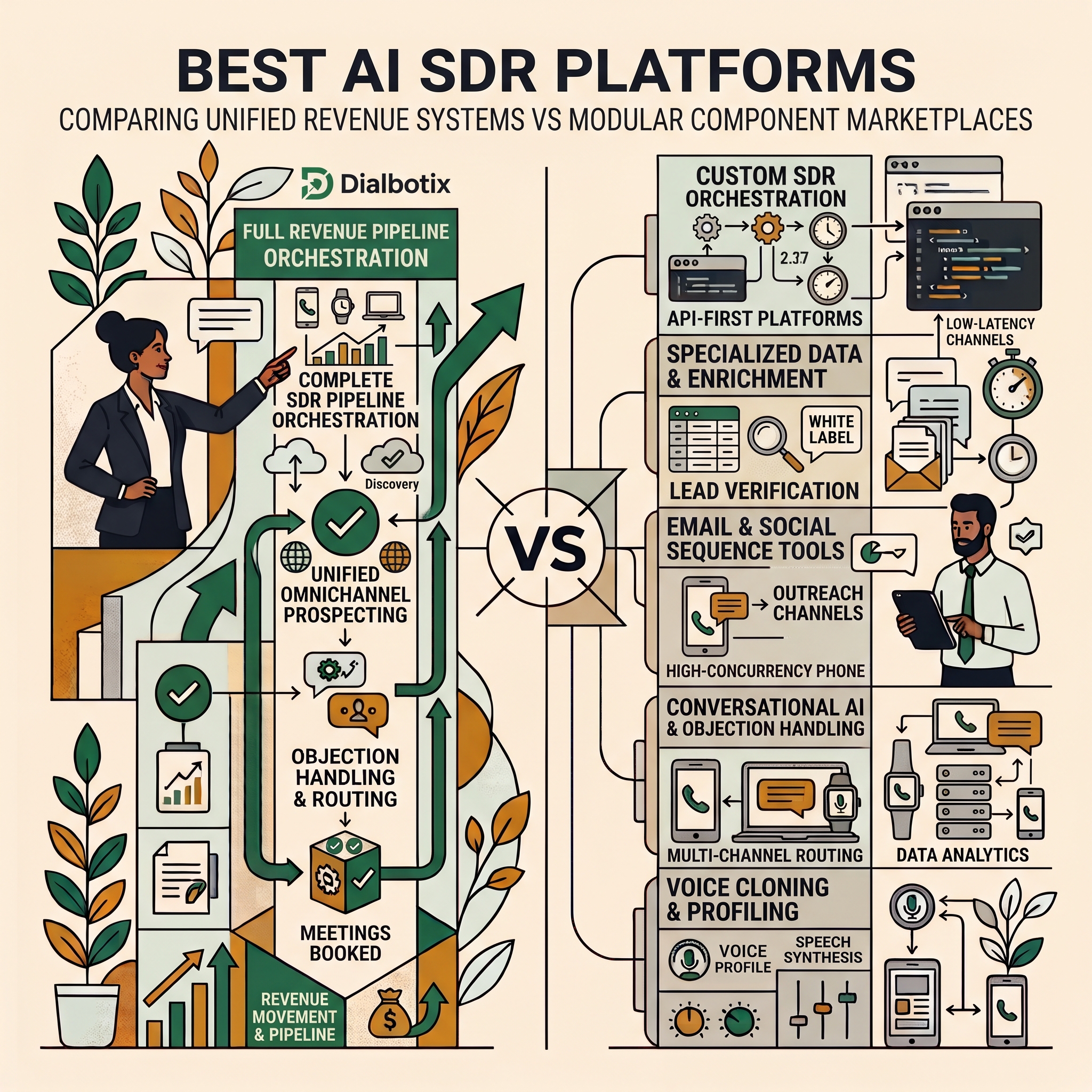
The category ranges widely: some AI SDR platforms are primarily email and LinkedIn automation tools, some are prospecting and data-enrichment engines, and some are voice-first systems built around live phone conversations. The exact workflow — and therefore the right platform — depends entirely on where your sales-development bottleneck actually is.

This distinction matters because not every AI SDR is a voice agent. Many AI SDR platforms are built around email, LinkedIn, prospect research, and outbound sequencing, with voice treated as an optional add-on channel rather than the core product.

Dialbotix takes a voice-first approach: it calls leads, conducts conversational qualification, identifies interest, books meetings, and pushes the resulting information into your sales systems. For teams that need a full multichannel AI SDR across email, LinkedIn, and phone, platforms such as 11x, Artisan, AiSDR, Regie.ai, and other outbound automation products may be a better fit. For teams where phone conversations are the critical bottleneck, a specialized AI voice agent can outperform a broad outbound automation platform on that specific job.

Who it's for

Who should use an AI SDR platform?

AI SDR software is most useful when repetitive sales-development work is consuming too much human time or when the business needs significantly more outbound capacity.

Prospecting teams

Automate account research, contact discovery, prospect identification, and initial outbound workflows.

Outbound email teams

Generate and manage personalized email campaigns and automated follow-up sequences.

Voice-first sales teams

Use AI voice agents to call prospects, hold conversations, qualify leads, and identify sales opportunities.

Lead qualification teams

Automatically determine which prospects meet predefined sales criteria before handing them to human representatives.

Appointment-setting teams

Move qualified prospects from outbound outreach into booked meetings.

Growing sales organizations

Increase outbound capacity without increasing SDR headcount at the same rate.

Methodology

How we compare AI SDR platforms

This isn't a feature checklist. Each platform below is evaluated on how well it actually executes the sales-development workflow it claims to automate — not on how many AI capabilities are listed on its homepage.

  1. 01

    Prospect discovery

    Evaluate how effectively the platform finds and identifies relevant companies, contacts, and prospects.

  2. 02

    Data quality

    Accurate and current contact information is critical because AI automation only amplifies the quality of the underlying data.

  3. 03

    Outbound channels

    Determine whether the platform supports email, LinkedIn, phone, SMS, or other channels relevant to your sales process.

  4. 04

    AI personalization

    The system should produce relevant outreach rather than simply generating large volumes of generic messages.

  5. 05

    Voice calling

    For voice-first sales workflows, evaluate conversational quality, latency, interruption handling, and outbound calling reliability.

  6. 06

    Lead qualification

    The agent should be able to identify intent and determine whether a prospect meets your qualification criteria.

  7. 07

    Appointment booking

    Qualified prospects should be able to move directly into calendar scheduling when appropriate.

  8. 08

    CRM integration

    Prospecting activity, replies, calls, qualification results, and meetings should synchronize with the CRM.

  9. 09

    Autonomy

    Evaluate how much of the workflow can run without human intervention and where human approval remains necessary.

  10. 10

    Analytics

    Look for campaign performance, response rates, qualified opportunities, meetings, call outcomes, and pipeline metrics.

At a glance

Best AI SDR platforms compared

AI SDR platforms are not interchangeable. Some are primarily multichannel outbound agents, some focus on prospecting and data, and Dialbotix is specifically optimized around AI voice conversations and phone-based qualification.

DialbotixThis one

$79/mo+

Voice AI
Core product
Lead Qualification
Built for sales
Booking
Built-in
CRM
Outbound
Voice-first
11x

Custom/enterprise

Voice AI
Lead Qualification
Booking
CRM
Outbound
Multichannel
Artisan

Sales-led

Voice AI
Limited/available
Lead Qualification
Booking
CRM
Outbound
Multichannel
AiSDR

$250/mo+

Voice AI
Limited
Lead Qualification
Booking
CRM
Integrations
Outbound
Email/LinkedIn
Regie.ai

Custom

Voice AI
Limited
Lead Qualification
Booking
CRM
Outbound
Multichannel
Apollo

$49/user/mo+

Voice AI
Phone
Lead Qualification
Booking
CRM
Outbound
Multichannel
Clay

Credit-based

Voice AI
Lead Qualification
Custom
Booking
Custom
CRM
Integrations
Outbound
Data/workflows
IncludedNot available
Verdict

The best AI SDR platforms in 2026

The ranking below separates broad AI SDR automation from voice-first sales execution. A platform that is excellent for email prospecting is not automatically the best option for a team whose main bottleneck is phone-based qualification.

1

Dialbotix

Best AI voice SDR platform

Dialbotix is a voice-first AI sales platform that automates outbound calling, conversational lead qualification, appointment booking, CRM updates, and sales follow-up.

Why it ranks here — Dialbotix ranks first for teams whose SDR workflow depends on phone conversations. Instead of treating voice as an optional channel around an email-first SDR, Dialbotix makes the AI voice conversation the core workflow. Teams can set up an AI voice agent in about two minutes without writing code.

Strengths
  • Voice-first AI SDR workflow
  • No-code setup
  • Outbound AI calling
  • Conversational lead qualification
  • Automatic appointment booking
  • Campaign management
  • CRM synchronization
  • Google Calendar integration
  • Live call monitoring
  • Live transcripts
  • AI call summaries
  • Call analytics
  • API and webhooks
Trade-offs
  • More specialized around voice than broad multichannel AI SDR platforms
  • Not designed to replace every prospecting, enrichment, and email function in a full GTM stack
Pricing

Starter $79/month for 300 AI calling minutes; Growth $149/month for 800 minutes; Scale $299/month for 2,000 minutes; pay-as-you-go at $0.25 per call minute.

Best for

Sales teams that want AI to handle outbound phone conversations, qualify leads, and book meetings.

2

11x

Best for autonomous multichannel SDR workflows

11x is an autonomous AI SDR platform designed to automate sales development across multiple outbound channels, including phone through its AI phone agent.

Why it ranks here — 11x is one of the clearest examples of the broad autonomous AI SDR model. It is a strong fit for companies that want an AI worker operating across prospecting and multiple outreach channels rather than a voice-only system.

Strengths
  • Autonomous outbound workflows
  • Multichannel outreach
  • AI sales agents
  • AI phone capabilities
  • Prospecting automation
  • Meeting generation
  • Enterprise-oriented workflows
Trade-offs
  • More expensive and enterprise-oriented than self-serve voice products
  • Longer implementation can be required
  • The broad autonomous model may be unnecessary for teams primarily focused on phone qualification
Pricing

Pricing is sales-led and can involve substantial annual commitments depending on the plan and deployment.

Best for

Mid-market and enterprise teams seeking broad autonomous sales-development automation.

3

Artisan

Best all-in-one AI BDR

Artisan provides an autonomous AI BDR approach centered around automating outbound prospecting and sales development.

Why it ranks here — Artisan is relevant for teams that want a broader AI employee model rather than a specialized phone agent.

Strengths
  • Autonomous outbound
  • Prospecting
  • AI-generated outreach
  • Multichannel workflows
  • Meeting generation
  • Sales automation
Trade-offs
  • More focused on broad outbound than voice-first sales
  • Pricing and onboarding can be sales-led
  • Teams may still need additional systems for specialized voice workflows
Pricing

Pricing is sales-led and varies by plan, lead volume, and deployment.

Best for

Companies looking for a broader autonomous AI BDR rather than a dedicated voice agent.

4

AiSDR

Best transparent AI SDR

AiSDR is an AI SDR platform focused on automating outbound prospecting and outreach with relatively transparent published pricing.

Why it ranks here — AiSDR is attractive to smaller teams that want an AI SDR with a clearer self-serve pricing model and a focus on outbound sales development.

Strengths
  • AI prospecting
  • Outbound automation
  • Email and LinkedIn workflows
  • Meeting generation
  • Published pricing
  • Self-serve orientation
Trade-offs
  • Voice is not its central product capability
  • Less suitable for teams where phone conversations are the main qualification channel
  • Data and outreach volume remain important constraints
Pricing

Published 2026 pricing includes tiers around $250/month, $900/month, and $2,500/month depending on the plan.

Best for

Smaller sales teams looking for transparent AI-powered outbound automation.

5

Regie.ai

Best for AI-assisted SDR teams

Regie.ai combines AI prospecting and sales engagement capabilities with workflows designed to support sales teams and representatives.

Why it ranks here — Regie is a strong fit when companies want AI to augment an existing sales organization rather than completely replace the human SDR workflow.

Strengths
  • AI prospecting
  • Sales engagement
  • Personalized outreach
  • AI agents
  • CRM integration
  • Human-in-the-loop workflows
Trade-offs
  • Not primarily voice-first
  • Best value can depend on an existing sales organization
  • Pricing is generally sales-led
Pricing

Custom pricing depending on deployment and requirements.

Best for

Established sales organizations combining human SDRs with AI automation.

6

Apollo

Best all-in-one prospecting stack

Apollo combines sales intelligence, contact data, prospecting, sequencing, and outbound sales functionality in a broad sales platform.

Why it ranks here — Apollo is useful when a team wants prospect data and outbound execution in the same platform rather than a dedicated autonomous AI SDR.

Strengths
  • Large prospecting database
  • Contact discovery
  • Email sequences
  • Phone capabilities
  • Sales engagement
  • CRM integrations
  • Self-serve pricing
Trade-offs
  • Not a dedicated autonomous AI voice agent
  • AI SDR functionality is broader sales automation rather than a voice-first agent
  • Teams may need additional AI calling software
Pricing

Published plans start around $49 per user per month depending on billing and plan.

Best for

SMB and mid-market teams that need prospect data and outbound sales tools together.

7

Clay

Best for prospecting workflows

Clay is a data and workflow platform that enables teams to build sophisticated prospecting, enrichment, research, and outbound workflows.

Why it ranks here — Clay is powerful for teams that want to build highly customized GTM workflows rather than buy a turnkey autonomous SDR.

Strengths
  • Data enrichment
  • Prospect research
  • Workflow automation
  • AI personalization
  • Large integration ecosystem
  • Highly customizable
Trade-offs
  • Not a turnkey AI SDR
  • Not a voice calling platform
  • Requires more workflow design
  • Calling and qualification generally require additional tools
Pricing

Credit-based pricing with plans ranging from free usage to substantially larger monthly plans.

Best for

Technical GTM teams building custom prospecting and enrichment systems.

Deep dive

AI SDR platforms: detailed comparison

Dialbotix vs 11x

11x targets broad autonomous sales development across multiple channels, while Dialbotix specializes in the phone conversation, qualification, appointment booking, and voice-based sales workflow.

Dialbotix vs Artisan

Artisan approaches the problem as an autonomous AI BDR, while Dialbotix focuses specifically on voice-first outbound sales execution.

Dialbotix vs AiSDR

AiSDR is centered on AI-powered outbound prospecting and messaging, while Dialbotix is centered on live AI phone conversations.

Dialbotix vs Regie.ai

Regie.ai is designed around AI-assisted sales development and broader engagement workflows, while Dialbotix specializes in autonomous voice conversations.

Dialbotix vs Apollo

Apollo combines sales intelligence and outbound engagement, while Dialbotix focuses on the conversational phone layer of sales development.

Dialbotix vs Clay

Clay is a flexible data and workflow platform, while Dialbotix provides a ready-to-run AI voice agent for outbound sales.

AI SDR vs AI voice agent

AI SDR is the broader category covering sales-development automation, while an AI voice agent specializes in conducting spoken phone conversations.

AI SDR voice calling

Voice adds a real-time conversational channel to AI SDR workflows and can be particularly valuable for qualification and appointment setting.

AI lead qualification

AI can qualify prospects by asking structured questions, interpreting responses, and determining whether a lead should move to human sales.

AI appointment setting

Appointment-setting agents turn qualified interest into scheduled meetings and reduce manual scheduling work.

AI SDR CRM integration

CRM synchronization allows prospecting activity, conversations, qualification outcomes, and meetings to become usable sales data.

AI SDR analytics

The most useful analytics track replies, qualified leads, meetings, call outcomes, campaign performance, and pipeline contribution.

Decision guide

How to choose the best AI SDR platform for you

The biggest mistake is choosing an AI SDR based on how autonomous the demo looks. Start with the part of your sales-development workflow that is actually slowing the team down.

1

Identify your bottleneck

Determine whether your biggest problem is prospect discovery, data enrichment, email outreach, LinkedIn outreach, phone qualification, follow-up, or appointment booking.

2

Choose your channels

Decide whether you need email, LinkedIn, phone, SMS, or a combination of channels. Do not pay for a broad multichannel system if your primary bottleneck is one channel.

3

Evaluate data quality

An AI SDR cannot compensate for inaccurate contact information. Check how the platform sources, verifies, enriches, and updates prospect data.

4

Test real conversations

If voice is involved, test actual phone calls with interruptions, objections, unclear answers, silence, and unexpected questions before evaluating the system.

5

Check CRM and booking

Verify that qualified prospects, activity, call results, and meetings can flow into the CRM and calendar without manual duplication.

6

Measure pipeline economics

Compare total platform cost against qualified opportunities and meetings generated rather than measuring success by messages sent or calls completed.

Pricing

How much do AI SDR platforms cost?

AI SDR pricing varies dramatically because the products automate different amounts of the sales-development process. A lightweight email assistant may cost tens of dollars per month, while autonomous AI SDR products can cost thousands or require enterprise contracts.

Dialbotix pricing

Dialbotix starts at $79/month for 300 AI calling minutes. Growth is $149/month for 800 minutes, Scale is $299/month for 2,000 minutes, and pay-as-you-go calling is available at $0.25 per call minute. A 14-day free trial is available.

See full pricing
What affects total cost
Number of prospectsAI research volumeContact-data creditsEmail volumeLinkedIn activityAI calling minutesTelephonyLanguage-model usagePlatform subscriptionCRM integrationsImplementation costsHuman sales oversight

Do not compare AI SDR platforms only by monthly subscription. A broader autonomous platform can cost significantly more but automate more of the workflow. Conversely, a cheap email tool may still require separate data, calling, CRM, and qualification systems.

FAQ

Best AI SDR platforms FAQ

What is the best AI SDR platform in 2026?

The best platform depends on the part of sales development you want to automate. Dialbotix is a strong option for voice-first outbound sales and qualification, 11x and Artisan for broader autonomous SDR workflows, AiSDR for transparent AI outbound, Regie.ai for AI-assisted sales teams, Apollo for prospecting and engagement, and Clay for custom data workflows.

How do I choose between AI SDR platforms?

Start with your actual bottleneck rather than a feature list. If phone conversations and qualification are the constraint, prioritize voice-first platforms like Dialbotix. If prospecting or email volume is the constraint, prioritize data and outbound platforms like Apollo, AiSDR, or Clay.

What should I look for in an AI SDR platform?

Look at data quality, the channels it actually supports well (rather than lists), how lead qualification is handled, whether appointment booking is native or requires a separate tool, CRM synchronization, and total cost against qualified meetings produced, not messages or calls sent.

Are AI SDRs the same as AI voice agents?

No. AI SDR is the broader sales-development category. An AI voice agent is a specialized system that conducts spoken conversations over the phone. Some modern AI SDR platforms include voice as one of several channels.

What is the best AI SDR for phone calls?

For teams whose primary SDR workflow is phone-based, Dialbotix is a strong choice because it is built around outbound AI voice conversations, qualification, appointment booking, and CRM workflows.

Can AI SDRs make phone calls?

Some can. Voice support varies considerably across the category. Some AI SDR platforms are primarily email and LinkedIn products, while others include phone agents or calling capabilities.

Can AI SDRs qualify leads?

Yes. AI SDR systems can use qualification criteria to identify relevant prospects and determine whether a lead should progress to the next stage.

Can AI SDRs book meetings?

Yes. Meeting booking is one of the most common AI SDR outcomes. Platforms can connect qualification and outreach activity to calendars and meeting workflows.

Can an AI SDR replace a human SDR?

Some vendors position their products as capable of replacing significant parts of an SDR role, but complete replacement depends on the sales process. Humans remain important for strategy, complex conversations, negotiation, relationship building, and quality control.

What is the best AI SDR for small businesses?

Small businesses should generally prioritize transparent pricing, fast setup, manageable data requirements, and a clear path to measurable meetings. AiSDR, Apollo, and Dialbotix can each fit different small-business workflows depending on whether the priority is messaging, prospecting, or voice.

What is the best AI SDR for enterprise companies?

Enterprise teams should evaluate governance, integrations, data quality, security, implementation support, scalability, and channel coverage. Platforms such as 11x, Regie.ai, and other enterprise-oriented AI SDR products may be relevant.

How much do AI SDR platforms cost?

Pricing ranges from relatively inexpensive prospecting and email tools to autonomous AI SDR products costing hundreds or thousands of dollars per month or requiring annual enterprise contracts. Dialbotix starts at $79/month for 300 AI calling minutes.

Do AI SDR platforms need a CRM?

A CRM is not always technically required, but it becomes increasingly important as outbound volume grows. CRM synchronization prevents AI-generated activity and qualification data from becoming disconnected from the sales process.

Is voice better than email for AI SDR outreach?

Neither is universally better. Email is efficient for scalable asynchronous outreach, while voice provides real-time conversation and can qualify interest more directly. The best strategy often depends on the ICP and sales motion.

Give your SDR team an AI voice agent

If phone calls are the bottleneck in your outbound process, you do not need another email sequence. Set up a Dialbotix AI voice agent, call your leads, qualify conversations, and book meetings without writing code.