All comparisons
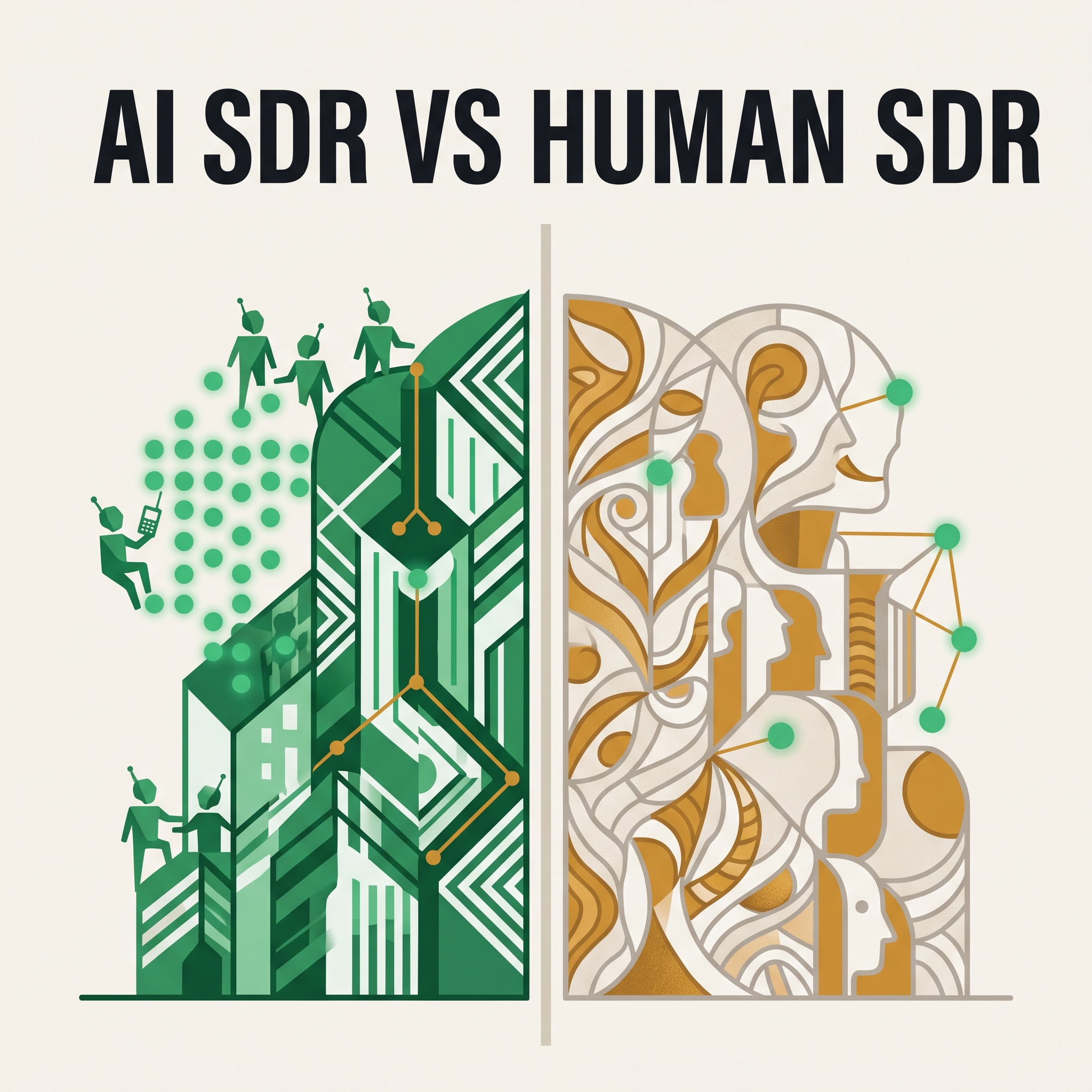
AI SDR vs Human SDR

AI SDR vs Human SDR Which Should You Use?

AI SDRs and human SDRs solve different parts of the sales development problem. Compare cost, scale, qualification, calling, follow-up, personalization, judgment, and where each approach works best.

Overview
AI SDRs are not simply cheaper human SDRs

AI SDRs are not simply cheaper human SDRs

The useful comparison is not whether AI can replace every SDR task. It is which parts of sales development should be automated and which still benefit from human judgment.

Human SDRs are strong at nuanced conversations, relationship building, complex objections, account strategy, and situations where context matters more than repetition.

AI SDRs are strong at repetitive, high-volume workflows. They can work through large lead lists, initiate conversations, qualify prospects against defined criteria, follow up consistently, and book meetings without requiring a human to perform every interaction.

Voice-first AI SDRs add another advantage: they can conduct phone conversations rather than relying exclusively on email or asynchronous messaging. This makes them particularly useful for businesses where calling is a major part of the sales process.

The strongest sales organizations do not necessarily have to choose one or the other. AI can handle repetitive top-of-funnel activity while human SDRs focus their time on qualified opportunities and conversations that require judgment.

Who it's for

When should you use an AI SDR?

AI SDRs are most valuable when the sales workflow contains a large amount of repeatable activity.

High-volume calling

Use AI when your team needs to contact large numbers of leads and manually calling every prospect is not practical.

Persistent follow-up

AI agents can systematically follow up with leads instead of depending on SDRs to remember every touchpoint.

Repeatable qualification

If qualification depends on clearly defined questions and criteria, AI can execute the first layer consistently.

Appointment setting

AI can move qualified prospects directly into calendar booking workflows.

Lean sales teams

Small teams can increase outbound capacity without immediately hiring a large SDR organization.

Methodology

How AI SDRs and human SDRs compare

The right choice depends on the task. Comparing the two across individual sales activities is more useful than treating either one as universally better.

  1. 01

    Scale

    AI can execute repetitive activities across large lead volumes simultaneously, while human capacity is constrained by working hours and headcount.

  2. 02

    Consistency

    AI follows configured instructions consistently. Humans can adapt more naturally but performance can vary between reps and situations.

  3. 03

    Conversation quality

    Humans generally have an advantage in ambiguous, emotional, strategic, or highly complex conversations.

  4. 04

    Cost structure

    AI generally uses software and usage costs, while human SDRs involve salary, benefits, management, training, and recruiting costs.

  5. 05

    Speed

    AI can respond and initiate workflows quickly without waiting for an SDR's availability.

  6. 06

    Judgment

    Humans remain stronger when the correct action depends on subtle context, business judgment, or unusual circumstances.

  7. 07

    Follow-up

    AI is particularly strong at repeatable follow-up sequences and persistent lead engagement.

  8. 08

    Relationship building

    Human SDRs have a natural advantage when trust, long-term relationships, and executive-level communication matter.

At a glance

AI SDR vs human SDR comparison

AI SDRs have a structural advantage in repetitive volume-based work, while human SDRs retain an advantage in complex judgment and relationship-driven selling.

DialbotixThis one

From $79/mo

Voice AI
Lead Qualification
Booking
CRM
Outbound
AI SDR

Software / usage based

Voice AI
Depends on platform
Lead Qualification
Automated
Booking
Automated
CRM
Usually integrated
Outbound
Human SDR

Salary + benefits + overhead

Voice AI
Human calling
Lead Qualification
Human-led
Booking
Human-led
CRM
Manual / assisted
Outbound
Hybrid SDR Team

Software + personnel

Voice AI
AI + human
Lead Qualification
AI + human
Booking
AI + human
CRM
Integrated
Outbound
IncludedNot available
Verdict

AI SDR vs human SDR: who wins?

There is no universal winner. The better approach depends on what you are trying to optimize. For repetitive outbound execution, AI has a structural advantage. For complex sales conversations, humans remain essential.

1

AI SDR

Best for Scale and Repetitive Sales Work

AI SDRs are best suited to repetitive, high-volume sales development tasks such as prospect outreach, qualification, follow-up, and appointment setting.

Why it ranks here — AI can perform the same workflow repeatedly without requiring another employee for every incremental lead. This makes it particularly valuable when the bottleneck is sales capacity rather than sales strategy.

Strengths
  • High-volume execution
  • Fast lead response
  • Consistent qualification
  • Persistent follow-up
  • Automated appointment booking
  • Lower incremental labor requirements
  • 24/7 workflow availability
  • Easy campaign replication
Trade-offs
  • Less effective for highly complex or ambiguous conversations
  • Requires careful configuration and monitoring
  • Quality depends heavily on workflow design and lead data
  • Should not be treated as a universal replacement for experienced salespeople
Pricing

Varies by platform. Software, usage, calling, contact, or enterprise pricing may apply.

Best for

High-volume outbound, lead qualification, follow-up, appointment setting, and repeatable sales development workflows.

2

Hybrid AI + Human SDR

Best Overall Sales Team Model

A hybrid model uses AI to handle repetitive top-of-funnel activity and humans to manage qualified opportunities and complex conversations.

Why it ranks here — For many businesses, this is the most practical model. AI increases capacity while humans remain responsible for judgment-heavy sales work.

Strengths
  • High scalability
  • Human oversight
  • Better use of SDR time
  • Automated qualification
  • Human handling of complex opportunities
  • Flexible escalation
Trade-offs
  • Requires coordination between AI and human workflows
  • More systems may need to be integrated
  • Human team still has to manage qualified opportunities
Pricing

AI software costs plus human SDR compensation and operating costs.

Best for

Growing sales organizations that want automation without removing human involvement from important opportunities.

3

Human SDR

Best for Complex Sales

Human SDRs remain valuable when selling requires nuanced judgment, strategic account development, relationship building, or complex conversations.

Why it ranks here — Human representatives can interpret context and adapt to situations that fall outside predefined workflows.

Strengths
  • Human judgment
  • Relationship building
  • Complex objection handling
  • Account strategy
  • Natural conversational adaptation
  • Escalation and negotiation
Trade-offs
  • Higher operating cost
  • Limited by working hours
  • Recruiting and training requirements
  • Performance can vary between representatives
  • Repetitive follow-up consumes valuable time
Pricing

Salary, benefits, recruiting, training, management, tools, and other employment costs.

Best for

Complex B2B sales, strategic accounts, relationship-driven selling, and opportunities requiring significant human judgment.

Deep dive

AI SDR vs human SDR: detailed comparison

Cost

AI SDRs typically replace some variable labor costs with software and usage costs. Human SDRs carry salary, benefits, recruiting, training, management, and tooling costs.

Scalability

AI has a major advantage when the number of leads increases. A human team generally needs additional headcount to maintain the same outreach volume.

Cold calling

AI voice agents can make large numbers of calls and conduct consistent conversations. Human SDRs remain stronger for nuanced conversations and complex objections.

Lead qualification

AI works well when qualification criteria are structured and repeatable. Humans are better when qualification depends on subtle context or strategic judgment.

Follow-up

AI is highly effective at persistent follow-up because it can execute predefined workflows without relying on memory or individual rep discipline.

Appointment setting

AI can automatically move qualified prospects toward calendar booking, reducing administrative work for SDRs.

Personalization

AI can personalize outreach based on available data, but human SDRs generally have an advantage when personalization requires deep account understanding or genuine relationship context.

Objection handling

AI can handle common and predictable objections. Humans are still better suited to unusual objections, negotiations, sensitive situations, and high-value conversations.

Working hours

AI agents can operate continuously, while human SDR activity is constrained by staffing and schedules.

CRM management

AI can automatically capture and synchronize activity, while human SDRs often have to manually update or verify CRM information.

Human escalation

The strongest AI SDR workflows include clear escalation rules so qualified or complicated conversations can be handed to a human.

Revenue impact

The correct measurement is not how many calls or messages an SDR completes. Compare qualified opportunities, booked meetings, show rates, pipeline, and revenue generated.

Decision guide

Should you hire an SDR or use AI?

Use the following decision framework instead of assuming that either AI or humans should handle the entire sales process.

1

Identify the bottleneck

If your problem is insufficient lead volume, data quality, or sales strategy, hiring or adding AI may not solve the underlying issue. Identify the actual constraint first.

2

Measure repetitive work

Estimate how much SDR time is spent on repetitive calling, qualification, follow-up, scheduling, and CRM updates.

3

Separate simple from complex

Automate predictable interactions and reserve human SDR time for conversations that require judgment, negotiation, or relationship building.

4

Calculate total cost

Compare AI software and usage costs with the fully loaded cost of additional SDR headcount rather than comparing software price with salary alone.

5

Test with real leads

Run a controlled campaign and compare AI and human performance using the same lead quality and sales criteria.

6

Build escalation rules

Define when an AI SDR should continue independently and when a qualified, sensitive, or complex conversation should be transferred to a human.

Use cases

Where AI SDRs and humans work best

The strongest division of labor assigns repetitive execution to AI and high-context work to humans.

Cold outbound calling

AI can handle large calling campaigns while human SDRs focus on prospects that meet defined qualification criteria.

Lead qualification

AI can ask consistent questions and score or categorize prospects before human involvement.

Lead follow-up

AI can maintain consistent follow-up across large lead lists.

Appointment setting

AI can identify interest and move qualified prospects into calendar booking.

Dormant lead reactivation

AI can revisit old leads at scale while humans handle prospects that re-engage.

Inbound qualification

AI can handle initial questions and qualification before routing valuable opportunities to the sales team.

Complex account selling

Human SDRs and account executives should handle strategic opportunities requiring deeper account knowledge and judgment.

CRM administration

AI can automatically capture call outcomes, summaries, transcripts, and qualification information.

Hybrid sales development

AI performs the repetitive first layer while human SDRs handle qualified and high-value conversations.

Pricing

AI SDR cost vs human SDR cost

The headline subscription price is only one part of the comparison. The useful calculation is the cost of producing a qualified opportunity.

Dialbotix AI SDR pricing

Dialbotix starts at $79/month for 300 AI calling minutes. Growth is $149/month for 800 minutes, Business is $299/month for 2,000 minutes, and pay-as-you-go calling is $0.25 per minute. A 14-day free trial is available.

See full pricing
What affects total cost
AI subscriptionCalling minutesLead and contact volumeData enrichmentCRM costsHuman SDR salariesBenefits and employment costsRecruiting and trainingManagement overheadCost per qualified opportunity

Do not assume AI is automatically cheaper. If an AI system produces poor-quality conversations or unqualified meetings, a low software bill does not translate into better sales economics. Measure qualified pipeline and revenue.

FAQ

AI SDR vs human SDR FAQ

Is an AI SDR better than a human SDR?

Neither is universally better. AI SDRs are generally better at repetitive, high-volume sales development tasks, while human SDRs are stronger at complex conversations, judgment, relationship building, and unusual objections.

Can AI SDRs replace human SDRs?

AI SDRs can automate significant portions of SDR work, but they should not be treated as a universal replacement for human salespeople. Many teams will benefit more from using AI to increase human SDR capacity.

Are AI SDRs cheaper than human SDRs?

AI SDRs can have lower direct operating costs for repetitive work, but the correct comparison includes software, usage, lead data, human oversight, and the quality of opportunities generated.

Can an AI SDR make cold calls?

Yes. Voice-first AI SDR platforms can make outbound calls, conduct conversations, qualify leads, handle common objections, and book appointments.

Can AI SDRs qualify leads better than humans?

AI can be more consistent when qualification is based on clear criteria. Humans generally have an advantage when qualification requires interpreting ambiguous context or business nuance.

Can AI SDRs book meetings?

Yes. AI SDRs can book meetings when connected to scheduling systems and configured with appropriate qualification and booking workflows.

Are human SDRs still necessary?

For many businesses, yes. Human SDRs remain valuable for complex accounts, nuanced conversations, relationship building, escalation, and opportunities requiring judgment.

What should an AI SDR do instead of a human?

AI is best used for repetitive tasks such as initial outreach, high-volume calling, qualification against defined criteria, follow-up, appointment booking, and activity capture.

What should humans do instead of AI?

Humans should generally focus on strategic accounts, complex objections, relationship development, negotiation, unusual situations, and qualified opportunities where judgment matters.

What is a hybrid AI SDR model?

A hybrid model uses AI for repetitive top-of-funnel work and humans for qualified or complex opportunities. The AI expands capacity while the human team focuses on higher-value conversations.

Can Dialbotix replace an SDR?

Dialbotix can automate substantial SDR activities such as outbound calling, lead qualification, follow-up, and appointment booking. Whether it replaces a specific SDR role depends on the company's sales process and how much human judgment that role requires.

Is Dialbotix a no-code AI SDR?

Dialbotix is a no-code AI voice agent platform that can function as a voice-first AI SDR. Users can configure an agent and outbound workflow without writing code.

Can AI SDRs handle inbound leads?

Yes. Depending on the platform, AI agents can respond to inbound inquiries, qualify prospects, route conversations, and support receptionist-style workflows. Dialbotix is also expanding beyond outbound sales into inbound and receptionist use cases.

How do you measure an AI SDR?

Measure connection rate, conversation rate, qualification rate, booked meetings, meeting show rate, cost per qualified lead, pipeline generated, and revenue rather than simply measuring activity volume.

What is the best AI SDR for phone-based sales?

For no-code, voice-first outbound calling, lead qualification, follow-up, and appointment booking, Dialbotix is a strong fit. Digital-first teams may prefer AI SDR platforms focused on prospecting, enrichment, and email automation.

Automate the repetitive work. Keep humans where they matter.

Use Dialbotix to automate high-volume calling, qualification, follow-up, and appointment booking while your sales team focuses on qualified opportunities and complex conversations.