All comparisons
AI SDR Pricing

AI SDR Pricing Compared

AI SDR pricing can range from affordable monthly software to usage-based and enterprise contracts. Compare pricing models, real costs, calling costs, contact limits, and what you actually get for your money.

Overview
How much does an AI SDR cost?

How much does an AI SDR cost?

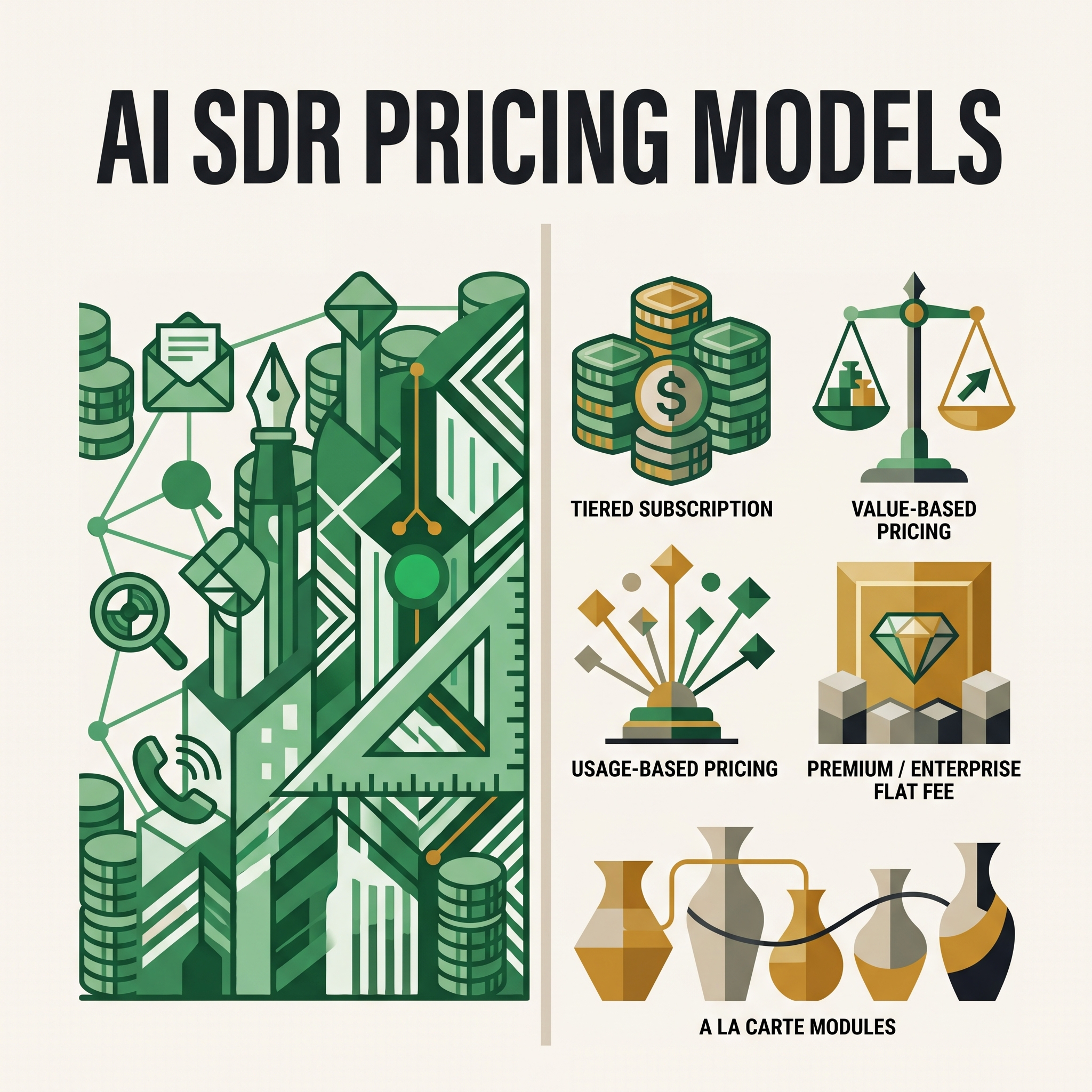
There is no single AI SDR pricing model. Different products charge for seats, contacts, messages, AI usage, calling minutes, or enterprise access.

Digital-first AI SDR platforms often combine prospecting, data enrichment, email generation, sequencing, and sales engagement. Their pricing may depend on users, contacts, credits, or usage.

Voice-first AI SDR platforms introduce another major pricing variable: calling minutes. A platform can appear inexpensive at the subscription level while becoming significantly more expensive as call volume increases.

The right comparison is therefore not simply the monthly subscription. You need to calculate the total cost of reaching, qualifying, and converting your target number of leads.

For businesses evaluating AI SDR software, cost per qualified conversation, cost per booked meeting, and ultimately cost per opportunity are more meaningful than software price alone.

Who it's for

Who should evaluate AI SDR pricing?

AI SDR pricing matters most when you are comparing automation against SDR headcount or deciding which sales workflow to automate.

Small sales teams

Teams can compare whether AI provides enough sales capacity without immediately adding another SDR.

Growing companies

Companies scaling outbound activity can model how software costs change as lead and conversation volume increases.

Calling-heavy teams

Teams using AI voice agents need to understand calling-minute costs and how usage affects total spend.

Agencies

Agencies need to consider client volume, recurring usage, margins, and whether one platform can support multiple campaigns.

Revenue teams

Sales leaders can compare AI SDR costs against qualified meetings, pipeline, and revenue generated.

Methodology

How to evaluate AI SDR pricing

The cheapest AI SDR is not necessarily the lowest-cost sales solution. Evaluate the complete cost structure and the output generated by the system.

  1. 01

    Base subscription

    Determine the fixed monthly or annual software cost before usage and additional services.

  2. 02

    Seats

    Check whether pricing increases with users, team members, agents, or workspaces.

  3. 03

    Contact volume

    Some platforms limit the number of contacts or prospects that can be stored, enriched, or contacted.

  4. 04

    Usage

    Understand whether calls, messages, AI generations, credits, or other actions consume additional usage.

  5. 05

    Calling minutes

    Voice AI pricing can depend heavily on the number and duration of calls.

  6. 06

    Data enrichment

    Prospecting platforms may charge separately for finding or enriching contact information.

  7. 07

    Integrations

    Check whether CRM, calendar, API, webhook, or other integrations are included or require higher tiers.

  8. 08

    Human oversight

    Calculate the internal labor needed to configure, monitor, correct, and manage the AI SDR.

At a glance

AI SDR pricing comparison

Pricing models vary widely. Use these categories to understand the commercial structure rather than assuming every AI SDR charges in the same way.

DialbotixThis one

From $79/mo

Voice AI
Lead Qualification
Booking
CRM
Outbound
11x

Custom / sales-led

Voice AI
Limited / varies
Lead Qualification
Booking
CRM
Outbound
Artisan

Sales-led

Voice AI
No / limited
Lead Qualification
Booking
CRM
Outbound
AiSDR

Plan / usage based

Voice AI
Limited
Lead Qualification
Booking
CRM
Outbound
Regie.ai

Sales-led

Voice AI
Limited
Lead Qualification
Booking
CRM
Outbound
Apollo

Free / paid plans

Voice AI
Lead Qualification
Booking
CRM
Outbound
Clay

Plan / usage based

Voice AI
Lead Qualification
Workflow-dependent
Booking
Workflow-dependent
CRM
Outbound
Reply.io

Per-user / plan based

Voice AI
No / limited
Lead Qualification
Booking
CRM
Outbound
Vapi

Usage-based

Voice AI
Lead Qualification
Custom
Booking
Custom
CRM
Custom
Outbound
IncludedNot available
Verdict

AI SDR pricing: best options by budget

The best option depends on whether you prioritize predictable monthly costs, prospecting infrastructure, autonomous digital outreach, or voice-based sales automation.

1

Dialbotix

Best Transparent AI Voice SDR Pricing

Dialbotix offers straightforward subscription tiers based primarily on AI calling capacity, making it easier for teams to estimate voice-sales costs.

Why it ranks here — Dialbotix combines AI voice calling, lead qualification, appointment booking, campaign management, CRM integrations, and call analytics with published pricing. The pricing structure is particularly useful for teams that want to understand their monthly calling capacity before scaling.

Strengths
  • Published pricing
  • Starter plan at $79/month
  • 300 AI calling minutes on Starter
  • 800 minutes on Growth
  • 2,000 minutes on Business
  • Pay-as-you-go option
  • No-code deployment
  • Lead qualification and booking included
  • CRM and calendar integrations
  • 14-day free trial
Trade-offs
  • Calling volume affects total cost
  • Teams focused primarily on email prospecting may need a different platform
  • Large enterprise deployments may require sales-led discussions
Pricing

Starter $79/month for 300 AI calling minutes; Growth $149/month for 800 minutes; Business $299/month for 2,000 minutes; pay-as-you-go at $0.25 per minute. 14-day free trial available.

Best for

Businesses that want predictable, no-code AI voice SDR pricing for outbound calling, qualification, follow-up, and appointment booking.

2

Apollo

Best for Lower-Cost Prospecting Infrastructure

Apollo combines prospect data and sales engagement features with free and paid plans.

Why it ranks here — Apollo can be attractive when prospect discovery and digital sales engagement are more important than autonomous voice calling.

Strengths
  • Free entry point
  • Prospect database
  • Sales engagement
  • Email sequencing
  • CRM capabilities
Trade-offs
  • Not a voice-first AI SDR
  • Costs can increase with advanced data and usage requirements
  • More focused on sales intelligence and engagement
Pricing

Free and paid plans are available, with pricing depending on features, users, and usage.

Best for

Teams looking for affordable prospecting and sales engagement infrastructure.

3

Reply.io

Best for Per-User Sales Engagement

Reply.io provides sales engagement and multichannel outreach with plan-based pricing.

Why it ranks here — Reply.io is useful for teams that want structured digital outbound sequences and sales engagement without adopting a primarily voice-based platform.

Strengths
  • Multichannel sequences
  • Email automation
  • Sales engagement
  • Team workflows
Trade-offs
  • Primarily digital outreach
  • Per-user pricing can scale with team size
  • Not primarily an AI voice SDR
Pricing

Per-user and plan-based pricing.

Best for

Sales teams that want structured digital outbound engagement.

4

Clay

Best for Flexible GTM Workflows

Clay provides data enrichment and workflow automation that can support sophisticated outbound programs.

Why it ranks here — Clay can be powerful for teams that care more about data quality and workflow flexibility than a turnkey AI SDR.

Strengths
  • Data enrichment
  • Flexible workflows
  • GTM automation
  • Large integration ecosystem
Trade-offs
  • Usage can become complex to model
  • Requires workflow configuration
  • Not a turnkey voice SDR
Pricing

Plan and usage based.

Best for

Technical GTM teams building custom prospecting workflows.

5

AiSDR

Best for AI Outbound Automation

AiSDR focuses on automating digital prospecting and outbound sales activity.

Why it ranks here — AiSDR is relevant for teams that want an AI-driven digital outbound workflow and are comfortable with plan or usage-based pricing.

Strengths
  • AI outbound workflows
  • Prospecting automation
  • Automated outreach
  • Lead engagement
Trade-offs
  • Less differentiated for voice calling
  • Pricing can depend on usage and plan
  • Exact cost should be evaluated against actual outreach volume
Pricing

Plan and usage dependent.

Best for

Teams automating digital outbound prospecting.

6

Artisan

Best for Autonomous Digital Outbound

Artisan focuses on AI-powered outbound sales automation and autonomous digital prospecting.

Why it ranks here — Artisan is compelling for businesses looking for broader autonomous digital outbound capabilities rather than primarily voice-based SDR automation.

Strengths
  • AI outbound automation
  • Prospecting
  • Personalized outreach
  • Autonomous sales workflows
Trade-offs
  • Not primarily voice-based
  • Pricing is more sales-led
  • Total cost depends on deployment and workflow
Pricing

Primarily sales-led.

Best for

Companies evaluating autonomous digital outbound sales.

7

Regie.ai

Best for AI Sales Engagement

Regie.ai combines AI-generated sales content with sales engagement workflows.

Why it ranks here — Regie.ai is useful when messaging quality and digital sales engagement are central to the workflow.

Strengths
  • AI sales messaging
  • Sales engagement
  • Outbound workflows
  • Personalization
Trade-offs
  • Not primarily a voice SDR
  • Pricing is generally sales-led
  • May require additional tools for phone automation
Pricing

Primarily sales-led.

Best for

Sales organizations using AI for digital engagement and outbound messaging.

8

11x

Best for Enterprise Autonomous Sales

11x focuses on autonomous digital workers for sales and business development workflows.

Why it ranks here — 11x is relevant to larger organizations evaluating autonomous sales development rather than simple low-cost SDR software.

Strengths
  • Autonomous sales workflows
  • Digital prospecting
  • Enterprise positioning
  • Broader AI worker model
Trade-offs
  • Typically more enterprise-oriented
  • Pricing is not positioned as a simple low-cost monthly plan
  • Voice is not the primary differentiation
Pricing

Custom / sales-led.

Best for

Organizations evaluating enterprise autonomous sales agents.

Deep dive

AI SDR pricing: detailed cost comparison

Subscription pricing

Monthly subscription pricing provides predictable software costs, but you still need to account for usage limits and additional services.

Per-seat pricing

Per-seat models scale with the number of users. They can work well for sales teams but become more expensive as more employees need access.

Usage-based pricing

Usage-based pricing ties costs to activity such as AI generations, contacts, messages, or calls. It can align cost with volume but requires careful forecasting.

AI calling costs

Voice AI introduces calling-minute costs that can become a significant component of total spend for high-volume campaigns.

Contact and data costs

Prospecting platforms may charge based on contacts, enrichment credits, or access to data. These costs should be included when calculating total acquisition cost.

Enterprise pricing

Enterprise AI SDR deployments often use custom pricing based on volume, integrations, support, security requirements, and implementation scope.

Free trials

A free trial can help evaluate conversation quality and workflow performance before committing to a larger contract.

Overage costs

Check what happens when you exceed included minutes, contacts, messages, or credits. Overage rates can materially change the economics.

CRM integration

Determine whether CRM and calendar integrations are included in the plan or restricted to higher tiers.

Human management cost

AI SDR software still requires setup, monitoring, prompt or workflow optimization, and lead-quality management. Include that labor in your calculation.

Cost per qualified meeting

Calculate total AI spend divided by qualified meetings rather than comparing software subscriptions in isolation.

Cost per opportunity

The strongest financial metric is often the cost of generating a real sales opportunity or pipeline dollar, not the cost of producing activity.

Decision guide

How to choose an AI SDR based on price

Use the pricing model that best matches your sales volume and workflow instead of choosing the lowest advertised subscription.

1

Estimate monthly volume

Calculate how many prospects you expect to contact, how many calls or messages you expect to generate, and how many follow-ups each lead may require.

2

Calculate total usage

Translate your expected activity into calling minutes, messages, contacts, credits, or other billable units.

3

Include data costs

If the platform requires external lead databases or enrichment, include those costs in your total acquisition model.

4

Model human oversight

Estimate the time required to configure campaigns, monitor conversations, review outcomes, and handle escalations.

5

Calculate cost per outcome

Measure cost per qualified lead, booked meeting, opportunity, and revenue rather than simply cost per user.

6

Test before scaling

Use a trial or controlled campaign to validate actual conversion performance before increasing spend.

Use cases

AI SDR pricing by use case

Your use case directly affects which pricing model is most economical.

AI cold calling

Voice AI pricing should be evaluated primarily around calling minutes, connection rates, and qualified conversations.

Lead qualification

Compare the cost of automated qualification against the human SDR time required to manually qualify the same lead volume.

Appointment setting

Calculate cost per qualified meeting rather than cost per call or message.

Lead follow-up

Persistent automated follow-up can create value by increasing contact attempts without requiring additional SDR headcount.

Dormant lead reactivation

AI can make reactivation campaigns economical when large numbers of old leads would otherwise require manual outreach.

Digital prospecting

Email-first AI SDRs should be evaluated around contact, enrichment, generation, and sending costs.

Agency outbound

Agencies should model the economics across multiple clients, campaigns, and recurring usage.

Small-business sales

Small businesses should prioritize predictable pricing, low implementation cost, and measurable lead outcomes.

Hybrid SDR teams

AI can reduce the amount of repetitive work handled by human SDRs while leaving high-value opportunities with the sales team.

Pricing

Dialbotix pricing

Dialbotix uses a simple AI calling-minute model designed to make voice automation costs easier to understand.

Dialbotix plans

Starter costs $79/month and includes 300 AI calling minutes. Growth costs $149/month and includes 800 minutes. Business costs $299/month and includes 2,000 minutes. Pay-as-you-go calling is $0.25 per minute. A 14-day free trial is available.

See full pricing
What affects total cost
AI calling minutesMonthly subscriptionNumber of campaignsLead volumeCRM integrationsCalendar bookingCall recordings and transcriptsAI summaries and analyticsAdditional usageHuman oversight

Pricing information changes frequently across the AI SDR market. Verify the provider's current pricing, usage limits, overage rates, and included features before making a purchasing decision.

FAQ

AI SDR pricing FAQ

How much does an AI SDR cost?

AI SDR pricing ranges from relatively inexpensive monthly software to usage-based and enterprise contracts. The final cost depends on users, contacts, data, messages, calls, integrations, and usage.

What is the cheapest AI SDR?

The cheapest option depends on what you need. Some platforms offer free or low-cost entry plans, while others charge based on usage. A low subscription is not necessarily the lowest cost per qualified opportunity.

How much does an AI voice SDR cost?

AI voice SDR costs generally include a software subscription and calling usage. Dialbotix currently starts at $79/month for 300 AI calling minutes, with higher tiers and a pay-as-you-go option.

Does AI SDR pricing include calling?

Not always. Digital-first AI SDR platforms may focus on email and other digital channels, while voice platforms typically include or separately charge for calling minutes.

Is AI SDR cheaper than hiring an SDR?

It can be for repetitive sales development work, but the correct comparison includes AI software, usage, data, management, and human oversight versus the fully loaded cost of an SDR.

What is the best AI SDR pricing model?

The best pricing model depends on your workflow. Predictable subscriptions are easier to budget, while usage-based pricing can make sense when sales activity fluctuates.

Does Dialbotix have a free trial?

Yes. Dialbotix currently offers a 14-day free trial.

How much is Dialbotix?

Dialbotix currently starts at $79/month for 300 AI calling minutes. Growth is $149/month for 800 minutes, Business is $299/month for 2,000 minutes, and pay-as-you-go calling is $0.25 per minute.

Does Dialbotix charge per seat?

Dialbotix's published pricing is primarily structured around plan tiers and AI calling capacity rather than presenting the core price as a simple per-seat SDR license.

What should I calculate when comparing AI SDR pricing?

Calculate total monthly software and usage costs, then divide them by qualified leads, booked meetings, opportunities, or revenue generated. This gives a more useful economic comparison.

Do AI SDR tools charge for lead data?

Some do directly or indirectly. Prospecting platforms may use contact credits, enrichment credits, database limits, or integrations with external data providers.

Are AI SDR tools expensive for small businesses?

They do not have to be. Some platforms have low-cost entry plans. Small businesses should prioritize predictable costs and measurable outcomes rather than buying unnecessary enterprise functionality.

Can AI SDR pricing scale with sales volume?

Yes. Many AI SDR platforms use usage, contact, seat, or campaign limits that increase as sales activity grows.

Is usage-based AI SDR pricing better?

Usage-based pricing can be efficient when activity varies because costs follow consumption. The downside is that monthly spend can become less predictable as volume increases.

What is the most important AI SDR pricing metric?

Cost per qualified opportunity or cost per dollar of pipeline is generally more meaningful than subscription price alone.

See what an AI SDR costs in practice

Start with Dialbotix's no-code AI voice agent, test your real sales workflow, and measure the cost per qualified conversation and booked meeting.